State of Flux: Washington Supreme Court and Indian Rights

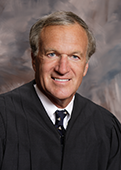
Washington Supreme Court Justice and longtime Indian fighter James M. Johnson announced his retirement from the high court last week.  For Indian law court watchers, Justice Johnson’s departure adds more excitement to an already dynamic time for the Court in terms of Indian jurisprudence. The recent voting record of the still-seated Washington State Supreme Court Justices in Indian cases, reveals some patterns for the justices:
Case

Pro-Tribal Interests

Anti-Tribal Interests

Wright (tribal corporate sovereign immunity) Madsen, Owens, Fairhurst C. Johnson, J. Johnson 
Eriksen (tribal detention of traffic offender in fresh pursuit, off reservation) Owens, C. Johnson Stephens, Wiggins, Fairhurst, Madsen, J. Johnson
Jim (tribal jurisdiction over Treaty in lieu sites) Owens, C. Johnson, Fairhurst, Stephens J. Johnson, Madsen, Wiggins
AUTO (tribal indispensability to third-party fuel compact challenges) Madsen, Owens, Fairhurst, González C. Johnson, J. Johnson, Stephens, Wiggins
Clark (state search warrant execution in Washington Indian Country) Unanimous (Fairhurst Opinion)

  Wright, AUTO and Jim best illustrate the very narrow split on the court when it comes to tribal sovereignty rights, with the Court’s most firmly conservative and anti-tribal (or as my colleague writes, “regressive”) position, prevailing in three out of the last four Indian cases.

While cases are not decided based on whether there is a tribal litigant on one side, appellate court judges do seem to develop voting patterns where Tribes are involved.  As you can see, Justice James Johnson has not surprisingly consistently ruled against tribal interests. Justice Wiggins seems squarely anti-tribal too.

Whoever Governor Inslee appoints to replace Justice James Johnson in May, who would then be up for election in November, stands to flip or maintain the Court’s recent anti-tribal position. In addition, Justices Charles Johnson, Fairhurst, and Stephens are up for reelection this year.

Justice Fairhurst has generally sided with pro-tribal majorities with the exception of criminal jurisdiction cases.  Her predisposition against tribal criminal authority was perhaps most clear during oral argument in Clark, when she expressed concerns in connection with Indian Country could serve as“an asylum for fugitives from justice.”  That is consistent with her positions in the Eriksen saga, which seem based mostly on a nuanced read of criminal procedure.

Justice Fairhurst’s reasoned dissent in AUTO was correct in observing, “[u]nder a proper CR 19(b) analysis, the Indian tribes are indispensable parties and they will be severely prejudiced by a state court judgment rendered in their absence. Because the majority incorrectly holds that the tribes are not indispensable parties, it seriously undermines the doctrine of sovereign immunity and weakens the law.”  So whatever opposition to tribal interests Justice Fairhurst showed in Clark and Eriksen are tempered by her dissent in AUTO.

Justice Stephens sided with the anti-tribal bloc in Eriksen and AUTO, which she authored.  As a former plaintiffs lawyer, her decision in AUTO appears to stem from an interest in advancing litigants’ right to sue.  She did after all side with tribal interests in Jim, which recognized tribal jurisdiction over tribal treaty fishing sites.

Justice Charles Johnson has twice voted pro-tribal, in Eriksen and Jim. He came down against tribal interests when he dissented in Wright – sort of.  While it may have been concerning at the time, he simply found to many factual discrepancies to hold that the tribal corporations at issue constituted “tribal entities.”

All of this recent Indian history in Washington’s high court goes to show that the four seats in play this year, most notably Justice James Johnson’s, are crucial to the protection of tribal sovereignty interests in Washington State.

Next Justice Elections

2014 Charles W. Johnson, Justice

2014 Mary E. Fairhurst, Justice

2014* James M. Johnson, Justice (position through 2016)

2014 Debra L. Stephens, Justice

2016 Barbara A. Madsen, Chief Justice

2016 Charles K. Wiggins, Justice

2018 Susan Owens, Justice                      

2018 Steven C. González, Justice

2018 Sheryl Gordon McCloud, Justice

Anthony Broadman is a partner at Galanda Broadman PLLC.  He can be reached at 206.321.2672, anthony@galandabroadman.com, or via www.galandabroadman.com.


Finishing What Slade Gorton Started: A Practical Argument Against Disenrollment

For an Indian law attorney, few insults cut as deeply as a comparison to former Senator Slade Gorton. For decades the Washington State Republican lawmaker attacked Tribal sovereignty, at one point introducing legislation that would authorize civil actions against tribes in Federal and state courts.  

So when such a comparison was recently made — i.e. that anti-disenrollment litigation essentially picks up where Gorton left off — I was impressed by its naiveté. The opposite is true. By proceeding recklessly with mass disenrollments and standing behind sovereign immunity even as to their own citizens, a handful of tribal governments are threatening the very existence of tribal sovereignty.

It is Tribes engaged in mass disenrollment efforts that threaten to complete Gorton’s work. What Gorton failed to achieve in Congress, membership-eliminating Tribes will achieve on the ground in Indian Country. Tribes will not be able to halve and quarter their memberships and maintain their position in the federalist structure. Tribes will not be able to violate their members’ human rights while Congress, in particular, sits idly by. They will create too many enemies. Critical race theorists posit that 19th Century federal policies of termination dovetail with the Tribal self-termination of the 21st Century. The argument might go that blood quantum in particular and membership ordinances in general will inherently destroy tribes — that the federal government will achieve through inter-marriage and tribal self-governance in enrollment practices what it couldn’t accomplish through Termination and the Dawes Act. Those arguments are as accurate as anything else in the sordid context of political disenrollment — TV shows included.

But practically, if we believe that disenrollment will be the camel’s nose under the tent for tribal sovereignty, the prudent approach is to make a kind of Pascal’s wager, and take the safe road. Through court battles, anti-disenrollment and human-rights activists will attack sovereign immunity. Tribal people will not lie down and let their governments tell them they are not Indian.

And while battles wage in court, enemies of tribes in federal and state office will use the chaos to attack tribal interests. Consider that often tribes use membership numbers to justify jurisdictional power or federal entitlements. If those numbers were fraudulent, don’t expect cash-strapped non-tribal governments to turn their cheeks. The incremental cost of not terminating members is insignificant compared with the abrogation of sovereign immunity or sovereignty that disenrollment will cause. So not only is there a theoretical basis for fighting disenrollment, but rationality requires us to wager that Tribes are stronger when they are either inclusive or static. A tribal government bets its very existence by disenrolling those who belong, or at least belonged under a previous administration. And because there are so many easy ways to avoid disenrollment — constitutional super-majority requirements as at Graton; statutes of limitation on disenrollment actions; moratoriums on enrollment; adoptions — it’s not a bet any government should make.

Anthony Broadman is a partner at Galanda Broadman PLLC. He can be reached at 206.321.2672, anthony@galandabroadman.com, or via www.galandabroadman.com.


Joe Sexton Featured as Attorney "Super-Commuter" in NWLawyer Magazine

Joe Sexton, Of Counsel at Galanda Broadman, is featured in this month’s edition of NWLawyer magazine as an attorney "super commuter."cover

Joe considered two factors as central to his decision to super-commute: time with his family and acquisition of his dream job. "I just had my first child," said Joe, "and my working from home provides flexibility in helping my wife care for our newborn." The arrangement also enables him to work for Seattle-based firm Galanda Broadman, which he describes as "one of the leading Indian law firms." . . .

Joe's firm is pretty high-tech. The five attorneys maintain near-constant contact via video chat and instant message. They also text and email. "Actually, I'm more in contact with my colleagues than I've ever been before in my career," Joe observed. Screenshot 2014-03-13 17.38.14 Joe has found that working remotely has actually strengthened his personal relationships. He reflected that most attorneys have put effort into maintaining a balance between their work and personal lives. "It's a constant work in progress," he observed, but "I think my love for what I do and for the clients I serve also helps me feel balanced and fulfilled in my personal relationships."

Joe Sexton is Of Counsel with Galanda Broadman, PLLC.  Joe’s practice focuses on tribal sovereignty issues, including complex land and environmental issues, and economic development matters.  He can be reached at (509) 910-8842 and joe@galandbroadman.com.

Gabe Galanda Signs On to Supreme Court Brief Re: Native Prisoners’ Religious Rights

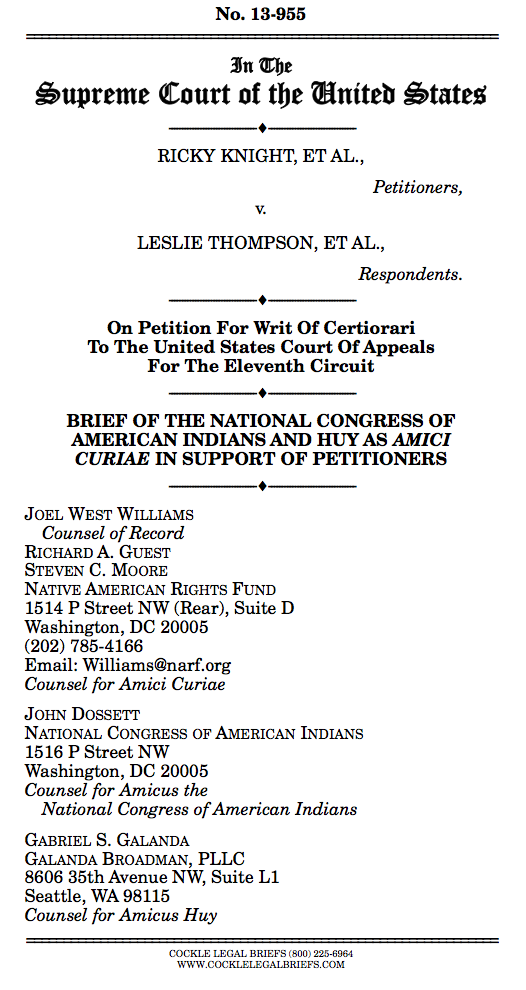
Gabe Galanda, Chairman of the Huy Board of Advisors, signed on to a U.S. Supreme Court amicus brief along with counsel for the Native American Rights Fund (NARF) and National Congress of American Indians (NCAI). Screenshot 2014-03-14 14.40.45

The brief urges the High Court to accept review of the Knight v. Thompson case, which involves an Alabama prison grooming policy that restricts Native inmates from wearing unshorn hair in accordance with tribal religion, as a companion case to Holt v. Hobbs, a similar case that the Court recently accepted for review.

Hobbs involves an Arkansas prison grooming policy that prohibits an inmate from growing a one-half-inch beard consistent with his religion.

Gabriel “Gabe” Galanda is the Managing Partner at Galanda Broadman. He is an enrolled member of the Round Valley Indian Tribes of Covelo, California. Gabe can be reached at 206.691.3631 or gabe@galandabroadman.com.

Gabe Galanda to Lecture on Tribal Disenrollment Law at Berkeley

On Monday, March 17, Gabe Galanda will lecture at UC Berkeley regarding the legalities associated with tribal disenrollment controversies. His remarks will be for the “Native American Critical and Legal Policy” seminar taught by Ethnic Studies professor, Thomas Biolsi. Gabe will speak from two essays recently published by his law firm: “An Essay on the Federal Origins of Disenrollment” and “An Essay on the Modern Dynamics of Tribal Disenrollment.” Professor Biolsi has included Roberts v. Kelly, a disenrollment controversy involving the Nooksack 306 that is currently pending before the Nooksack Judiciary, in his course syllabus. Gabriel “Gabe” Galanda is the Managing Partner at Galanda Broadman. He is an enrolled member of the Round Valley Indian Tribes of Covelo, California. Gabe can be reached at 206.691.3631 or gabe@galandabroadman.com.

An Essay on the Modern Dynamics of Tribal Disenrollment

Disenrollment is predominately about race, and money, and an "individualistic, materialistic attitude" that is not indigenous to tribal communities.

Because many tribes have maintained the IRA’s paternalistic and antiquated definition of “Indian” vis-a-vis blood quantum (as discussed in "An Essay on the Federal Origins of Disenrollment"), tribal membership has largely become “an explicitly racial conception of Indian identity.” Suzianne D. Painter-Thorne, If You Build It, They Will Come: Preserving Tribal Sovereignty in the Face of Indian Casinos and the New Premium on Tribal Membership, 14 Lewis & Clark L. Rev. 311 (2010).

The racial construct has worked well for disenrollment as "American Indians have one of the highest rates of interracial marriage in the U.S."  Gosia Wozniacka, Disenrollment leaves Native feeling 'culturally homeless', Associated Press, Jan. 21, 2014.  Indeed, Indians of any quantum (defined as "portion") of Indian blood are by federal design, multi-racial. In addition, "many Native Americans don’t live on reservations, speak Native languages or 'look' Indian, making others question their bloodline claims." Id.  In those illustrative ways, Indian conceptions of both race and class converge, with tribal classism also catalyzing disenrollment.

In turn, tribal officials who wish to target political foes or large swaths of politically weak or unpopular members, can “voluntarily invoke race-based definitions of ‘Indian’ [to] narrow the pool of tribal members, perhaps in an effort to limit gaming revenue and federal dollars to [those targeted] tribal members.”Painter-Thorne,  supra.  These disenrollment stories bear this out.   See e.g. Liz Jones, 'We'll Always Be Nooksack':Tribe Questions Ancestry of Part-Filipino Members, NPR/KUOW, Dec. 16, 2013; Joanne Barker, The True Meaning of Sovereignty, New York Times, Sept. 16, 2011.  1768978.t

The “forced transition to a cash economy” has likely played a large part in the dramatic spike in disenrollment as well.  Jana Berger & Paula Fisher, Navigating Tribal Membership Issues, Emerging Issues in Tribal-State Relations 61, 66 (2013).  Prior to the recent disenrollment epidemic, which is estimated to have already vanquished over 11,000 Indians, tribal governments were very inclusive, frequently wanting to have large "membership" numbers.  Aside from a greater amount of funding from federal agencies relative to increased tribal membership, from a practical standpoint tribal governments recognized that “there is strength in numbers.”  Id. 

But over the last couple decades, as tribes became more dependent on the U.S. economic free-market system, primarily through gaming entrepreneurship, disenrollment began to rear its ugly head.  According to Charles Wilkinson,

Just as federal education practices reverberated throughout tribes, so too did the forced transition to a cash economy. The concept of sharing, integral to Indian societies, did not jibe well with the individualistic, materialistic attitude that drove the nation’s economic system. As one Navajo stated, “When a relative needed help, you helped them out. When you needed something else, you could rely on a relative to help out, it all worked out in the long run. With money it doesn’t work anymore, now the relative with the money is expected to help out, what is needed for most everything is money and the poor relatives never have any.”

Blood Struggle: The Rise of Modern Indian Nations 54 (2006).

As Professor David Wilkins observes, tribal communities historically used ceremony and prayer to resolve intra-tribal tension or conflict; because traditionally speaking, "you don't cast out your relatives." Wozniacka, supra.  But today, when the political going gets rough in tribal communities, the individualistic, materialistic Indian attitude that Professor Wilkinson describes, increasingly leads to disenrollment of one's own relatives--instead of towards any holistic or indigenous values-based solution.

Galanda Broadman is an American Indian owned firm dedicated to advancing tribal legal rights and Indian business interests. The firm represents tribal governments, businesses and members in critical litigation, business and regulatory matters, especially in the areas of Indian Treaty rights, tribal sovereignty, taxation, commerce, personal injury, and human/civil rights.

Indian Lawyer Amber Penn-Roco Joins Galanda Broadman

Galanda Broadman has deepened its bench by adding another Indian lawyer: Amber Penn-Roco. Amber, an enrolled member of the Chehalis Tribe, comes to the firm as an Associate after a three-year stint at K+L Gates, Seattle’s second largest law firm.

DSC_4292

“Amber is one of the best and brightest young Indian lawyers around,” said Gabe Galanda, the firm’s managing partner.  “As our tribal law firm continues to grow, we remain very grateful to our tribal clients for the trust they put in us and the opportunity to fight for Indian Country.”

Amber’s practice focuses on complex land and environmental issues and multi-party litigation involving tribal sovereignty, torts and hazardous materials.  Her experience also includes work on transactional matters, including entity formation, environmental compliance and permitting.

Prior to working at K&L Gates, Amber worked in the Native American Unit of the Northwest Justice Project, which strives to afford access to justice to low-income tribal populations. She has served as a Governing Council Member of the Northwest Indian Bar Association.

Amber is a graduate of University of Washington School of Law, and Washington State University (summa cum laude).  While in law school, she served as President of both the Native American Law Students’ Association and the Minority Law Students’ Association.

Galanda Broadman was recently named to the 2014 Edition of U.S. News – Best Lawyers “Best Law Firms,” in the arena of Native American Law.  The six-lawyer firm, which styles itself  “An Indian Country Law Firm,” is dedicated to advancing tribal legal rights and Indian business interests.  With offices in Seattle, Washington and Bend, Oregon, the firm represents tribal governments, businesses and members in critical litigation, business and regulatory matters, especially in matters of Indian Treaty rights, tribal sovereignty and taxation.

Seattle Tribal Lawyer to Again Teach Minority Lawyers How To Build a Book of Business

On March 27, Gabe Galanda will help teach the King County Bar Association's annual Building a Book of Business: For Attorneys of Color program in Seattle. He delivered the same teachings last year.

KCBA's Diversity Committee is proud to host this annual seminar designed to give recently admitted attorneys of color the skills they need to advance in their careers.unique program is a closed door session where you will learn to effectively market yourself and acquire new clients for your firm. You'll gain valuable networking contacts and receive guidance from some of the most well-respected and successful leaders in our region's minority bar community.

In 2010, Gabe co-founded Galanda Broadman, PLLC, an American Indian owned law firm with six lawyers, and offices in Seattle, Washington and Bend, Oregon. Prior to that. Gabe founded the Tribal Practice Group at Williams Kastner, where he was a "first ballot" equity partner and an elected member of the firm's Board of Directors. Gabe has been named to the prestigious "40 Under 40" listing by Puget Sound Business Journal, and the "Native American 40 Under 40" listing by the National Center for American Indian Economic Development.

Gabriel "Gabe" Galanda is the Managing Partner at Galanda Broadman.  He is an enrolled member of the Round Valley Indian Tribes of Covelo, California.  Gabe can be reached at 206.691.3631 or gabe@galandabroadman.com.

An Essay on the Federal Origins of Disenrollment

Disenrollment is not indigenous to Native America.  It is a creature of the United States. The origins of tribal "disenrollment" are traced to the United States’ paternalistic assimilation policies of the 1930s.  (Federal Indian rolls and removal therefrom date back even further--to the early 1800s.)

In 1934 the U.S. Congress passed the Indian Reorganization Act (“IRA”), wherein the federal government took an extremely active role in framing tribal membership rules.  The IRA contained a definition of who would be recognized as an indigenous person by the federal government: The individual must be a descendant of a member residing on any reservation as of June 1, 1934, or a person “of one-half or more Indian Blood.”  25 U.S.C. § 476.

indian-country-disenrollment-termination-marty-two-bulls

The United States’ intent was to limit membership “to persons who reasonably can be expected to participate in tribal relations and affairs.”   Office of Indian Affairs, U.S. Dep't of the Interior, Circular No. 3123 (1935), reprinted in 2 Am. Indian Policy Review Comm'n, 94th Cong., Task Force No. 9 Final Report app. at 334 (Comm. Print 1977).  The IRA also urged tribes to adopt a constitution and included a boilerplate that tribes were encouraged to adopt.  And because tribal constitutions were subject to federal approval, the IRA definition of “Indian,” including its blood quantum requirement or some variation thereof, as well as concepts of "disenrollment," found their way into most tribal constitutions, even those that did not adopt the boilerplate IRA constitution.

In fact, even those tribes that opted to forego adopting a constitution were often persuaded to adopt these concepts somewhere in their organic law as a “consequence of the [federal government]’s control over federal services and tribal monies.”  Suzianne D. Painter-Thorne, If You Build It, They Will Come: Preserving Tribal Sovereignty in the Face of Indian Casinos and the New Premium on Tribal Membership, 14 Lewis & Clark L. Rev. 311, 341 (2010).

Thus, “while it is true that membership in an Indian tribe [wa]s for the tribe to decide, that principle is dependent on and subordinate to the more basic principle that membership in an Indian tribe is a bilateral, political relationship” under which the United States had set the terms.  Margo S. Brownell, Who is an Indian? Searching for an Answer to the Question at the Core of Federal Indian Law, 34 U. Mich. J.L. Reform 275, 307 (2001).  The Indian Self-Determination Education Assistance Act of 1975, additionally required that tribal governments devise formal membership regulations, in order for the tribe to receive certain federal self-determination funding.  The United States suggested such regulations, which like its boilerplate IRA constitutions, included notions of blood quantum and disenrollment.

In all, for the last 80 years, the United States has set the terms of tribal membership, i.e., "Indian," "blood quantum," "membership," "base rolls," and of course "disenrollment."  And for good measure, tribal acceptance and implementation of those unconscionable terms have been conditions precedent to self-determination funding since the 1970s.

Despite having invented disenrollment and foisted it upon tribal governments, the United States now suggests that it has no "business trampling on tribal sovereignty and self-governance" by interceding in tribal disenrollment disputes.  Or, as Nooksack Councilwoman Michelle Roberts -- a member of a the Nooksack 306 -- put it to Assistant Secretary of Indian Affairs Kevin Washburn: "It is Frankenstein in Indian country that the United States has created, and now ignores."

Galanda Broadman is an American Indian owned firm dedicated to advancing tribal legal rights and Indian business interests. The firm represents tribal governments, businesses and members in critical litigation, business and regulatory matters, especially in the areas of Indian Treaty rights, tribal sovereignty, taxation, commerce, personal injury, and human/civil rights.

Galanda Broadman Named Washington State Gaming Law Firm of the Year

Corporate INTL has named Galanda Broadman the Gaming Law Firm of the Year in Washington, for the second consecutive year. The awards commemorate those lawyers who have been successful over the past 12 months and who have shown excellence not only in expertise but in service.

For all of Corporate INTL's awards, they undertake detailed research via Corporate INTL's independent research and editorial teams. Corporate INTL then creates a shortlist of up to 5 potential winners in each category. The shortlisted firms are then reviewed by an independent awards panel in each country with the eventual winners chosen by that independent panel.

Galanda Broadman is an American Indian owned firm dedicated to advancing tribal legal rights and Indian business interests. The firm handles various Indian gaming transactional, regulatory and litigation matters.