
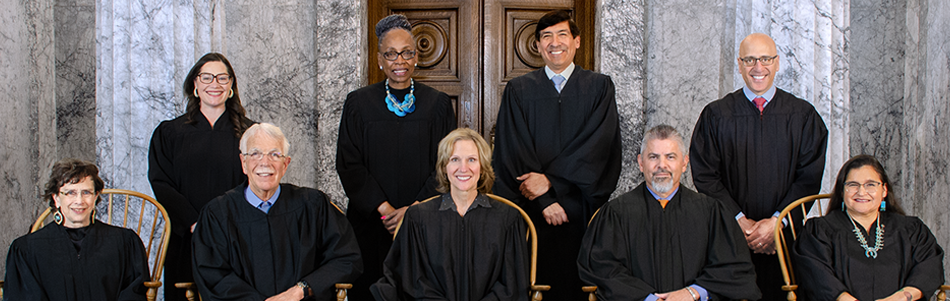
On June 5, the entire Washington State Supreme Court issued a historic proclamation recognizing the sovereignty and humanity of the First Peoples of Washington State.
The letter addressed to “Affiliated Tribes of Northwest Indians, Members of the Judiciary, and the Legal Community” is signed and issued by all nine Justices, in response to a 2024 ATNI Resolution titled, “Rectifying the Dehumanization of Indigenous People in State Legal Systems.”
ATNI’s Resolution called upon the Supreme Court “to issue a proclamation that urges action by those in the legal and judicial system to rectify the historical and continued dehumanization of Indigenous people in Washington state.”
The Supreme Court’s entire proclamation reads as follows:
Dear Affiliated Tribes of Northwest Indians, Members of the Judiciary, and the Legal Community:
We acknowledge that Washington State is on the traditional land of Tribal and Indigenous people. We honor their homelands and express gratitude to the descendants of the land and the land itself.
In October 2024, the Affiliated Tribes of Northwest Indians (ATNI) called upon this court to issue a proclamation urging action by those in the legal and judicial system to rectify the historical and continued dehumanization of the Indigenous people in Washington State.
Today, we issue this letter in response. We acknowledge Washington’s history of injustice towards Tribal and Indigenous communities and commit to continue taking steps to rectify past harms. We recognize that these communities have been vocalizing injustices for centuries.
We urge judges, the legal community, and lawyers to actively confront and rectify the historical and ongoing dehumanization of Indigenous people in Washington through their work, decisions, and daily practices.
We recognize that the history of this state, including state courts, is intertwined with racism and violence inflicted upon Indigenous people. This adversarial relationship began even before Washington was a state; with treaties negotiated under duress and the execution of important Tribal leaders.
We also recognize that history is reflected in our cities, towns, and communities. Thurston County, specifically, named after Samuel Thurston, reflects a racist legacy tied to rhetoric and actions that harmed Indigenous people. These legacies are not abstract. Native communities continue to face great systemic injustices from land dispossession, trauma from forced separation and incarceration through U.S. Indian boarding schools, overrepresentation in the child welfare, juvenile and criminal systems, higher rates of poverty, higher rates of missing persons, higher rates of sexual violence against Indigenous women and girls, and a lack of resources in education, healthcare, and infrastructure.
We recognize that at least 17 Indian boarding schools have been identified as operating in Washington between 1857 and 1932.1 This legacy of separating Indigenous children from their parents continues. As of 2015, Indigenous children in our state were represented in foster care at a rate 3.6 times greater than the general child population of the state.2
We recognize that this legacy of harm manifests in other places. For every 100,000 Indigenous people across Washington, 88 go missing, which is nearly three times the statewide average for all people.3 Although Indigenous people make up only 2% of our population, they account for about 6% of the state’s homicide victims.4 According to 2024 U.S. Census data, 19% of Indigenous people in our state reported living below the poverty line.5
We recognize that the dehumanization and discrimination of Indigenous communities in this state is not just the truth of the past but the reality of the present, including within our court system. Courts are where we hope people can come to seek redress. When those courts have been, and continue to be, inaccessible, harmful, and unjust for our Tribal communities, we must not just take accountability for the harm but strive to rectify it. June 5, 2026 Page 3
We take to heart Justice Montoya-Lewis’s call to justice and accountability at this court’s 2025 Minority and Justice Symposium,
As state actors we must understand at a fundamental level that Tribal sovereignty is not a gift that is given, but rather inherently rooted in centuries of self-governance...
State and federal systems have been responsible for grave injustices towards Tribal nations, through broken treaties and polices that have harmed generations of Native families... The harm continues to manifest itself in the disparities our communities face, including long-standing intergenerational trauma, cycles of violence and abuse, disappearance, premature deaths, and additional undocumented physiological and psychological impacts.6
This court has and will continue to take steps to rectify discrimination. For example, in 2020, this court affirmed core provisions of the federal and Washington State Indian Child Welfare acts (ICWA and WICWA). We ruled that a “broad interpretation” must be used in determining whether children facing removal have Tribal heritage, citing the history of state-sponsored removal of Native American children and the destruction of Native families and communities.7
In 2021, this court began opening each new term with formal land acknowledgements. We understand, however, that symbolic acknowledgement without action is insufficient.
In June of 2025, the court joined with Squaxin Island Tribe Chairman Kris Peters in co-convening the first Tribal-Judicial Summit, with the goal of sharing knowledge of tribal culture and history with state court judges and building intergovernment relationships.
In April of this year, this court entered an order establishing the Tribal State Court Consortium as a formal Supreme Court entity. The Consortium will continue to serve as a collaborative forum for state and Tribal judicial officers to foster mutual understanding and respect such that they can address evolving jurisdictional challenges, explore opportunities for shared solutions, and recommend educational opportunities that support culturally competent practices. This court has also acted through the recent Minority and Justice Symposium, the Tribal State Court Consortium, and traveling court. June 5, 2026 Page 4
We have been correcting offensive language in past decisions; language that was used to justify denying the recognition of treaty rights.
We have acknowledged opinions that erred by denying treaty rights. In 2024, our court recognized that a Yakama Nation member had a treaty right to hunt on open and unclaimed land and vacated Jim Wallahee’s 1924 conviction.8 In 2020, our court recognized that a Yakama Nation member had a treaty right to fish in their usual and accustomed waters and vacated Alec Towessnute’s 1916 conviction.9 Both decisions rebuked our court’s prior use of infantilizing and dehumanizing language of Tribal people, while affirming Indigenous people’s rights within Washington.
Our work will not end here. We acknowledge that these actions cannot undue centuries of harm and pledge ourselves to do more. We also call upon the bench and bar to actively address incorrect and harmful precedent, acknowledge conscious and unconscious bias, and change our judicial system to reflect a just reality for our Indigenous communities.
We cannot do this work alone and we cannot do it without the guidance of Tribal communities and Tribal courts. We look forward to strengthening those relationships, and relying on Tribal expertise, as we continue this work.


