
Silver Linings to Wash. Supreme Court's Playbook in State v. Clark

Today the Washington State Supreme Court ruled against a Colville tribal member and pro-tribal friends of the court in State v. Clark. But, in the case --which Gabe Galanda co-argued, on behalf of the ACLU--there are stark silver linings that affirm tribal sovereignty, especially in Washington Indian Country and Treaty territory. The case concerned whether a county search warrant, obtained and executed by city police without any attempt to involve the tribal police or court, lacked authority of law, since it authorized the search of a tribal member defendant’s home situated on reservation trust land. The Supreme Court affirmed the defendant's "conviction for theft because the trial court properly denied his motion to suppress evidence gathered on tribal trust land without a tribal warrant."

But the silver linings lie in the Court's reasoning:

Clark asks us to recognize the Colville Tribes' interest by adopting the test used by the Supreme Court of Idaho in Matthews, which measures the infringement of tribal sovereignty by looking to whether the State ignored governing tribal procedures while serving criminal process. Ifthe State did so, then under Matthews the State undermined tribal self-government. The material facts of Matthews are quite similar to those of Hicks: state police searched tribal property for an off-reservation crime. Hicks' holding has superseded Matthews for this particular factual scenario. However, we agree that Matthews serves as the starting point for searches of reservation lands where Hicks is distinguishable, such as where the crime occurs on reservation land over which the State has jurisdiction. Consequently, we hold that the State does not infringe tribal sovereignty by searching reservation lands unless it disregards tribal procedures governing the execution of state criminal process.

What this means is that state law enforcement must follow tribal procedures governing the execution of state criminal process, before searching reservation lands. In Clark, the Court found the Colville tribe's procedure wanting because it "does not govern the way the State executes its own process. Indeed, the tribal warrant provision does not guarantee that the State could execute its warrant as the tribal court could refuse to issue a tribal warrant."

Still, if tribes promulgate clear codified procedures for the execution of state process on reservation lands (18 U.S.C. 1151), states and state police must honor those procedures. And crucially, that is notwithstanding Nevada v. Hicks. This is the starkest silver lining from Clark.

The other silver lining lies in footnote 9 to the last page of the opinion: "Clark does not argue that any treaty provision creates governing procedures for executing a state search warrant . . . We do not foreclose the possibility that the State would infringe tribal sovereignty by disregarding governing procedures created by such provisions with our opinion today. See State ex rel. Merrill v. Turtle, 413 F.2d 683, 686 (9th Cir. 1969)."  In other words, Treaty tribes, such as all Stevens Treaty signatories, have an even stronger basis to force state police to honor codified tribal procedures that govern state process on reservation lands, especially through inherent territorial exclusion rights. That, too, is notwithstanding Hicks, which did not involve Treaty rights.

So although the decision was a tribal defeat, there are silver linings to the Washington Supreme Court's playbook in Clark.
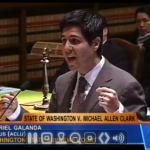
Gabriel "Gabe" Galanda is a partner at Galanda Broadman PLLC, of Seattle, an American Indian owned law firm.  He is an enrolled member of the Round Valley Indian Tribes of Covelo, California. Gabe assists tribal governments and businesses in all matters of tribal sovereignty and self-governance, especially in legal opposition to federal, state and local government encroachment.  Gabe can be reached at 206.691.3631 or gabe@galandabroadman.com.  His argument in Clark can be watched on TVW (at 35:49).

Carolina Supreme Court Goes Rogue: Immediately Orders Baby Veronica Removed

Little has changed since the Indian Child Welfare Act (“ICWA”) was enacted more than thirty years ago to address what Congressional testimony in 1974 revealed to be “the most tragic aspect of Indian life” — that is, the “wholesale removal of Indian children from their homes . . .” and their placement with non-Indian adoptive parents and foster homes.  Mississippi Band of Choctaw Indians v. Holyfield, 490 U. S. 30, 32 (1989). Last month the U.S. Supreme Court issued a decision diminishing the applicability of the ICWA, twisting the meaning of “continued custody” to find the statute inapplicable to prevent the removal of an Indian child from her biological father’s custody and home.  This was the tragic culmination of a long-running child-custody battle, widely reported in the press as the “Baby Veronica case.”

Baby Veronica’s father is a citizen of the Cherokee Nation and U.S. veteran who mistakenly signed away his parental rights on the eve of his deployment to war.  But when he discovered that an adoption of his child was at stake, he quickly moved to assert his inherent rights as a father so that he could raise his own daughter.  The Supreme Court’s holding quickly resulted in the summary eradication of an Indian father’s parental rights.

Beyond that tragedy, the Supreme Court’s decision threatens the efficacy of the statute enacted to address what the Court recalcitrantly acknowledged were “abusive child welfare practices that resulted in the separation of large numbers of Indian children from their families and tribes through adoption or foster care placement, usually in non-Indian homes.”

In a move showing that little if any real progress for Indian children and Indian Country as a whole has been made since the ICWA’s enactment, the South Carolina Supreme Court went a large and destructive step beyond the High Court’s mandate in the Baby Veronica case.  Because the  Court’s order was limited to a finding that the ICWA was inapplicable in this case, the lower courts should still be able to consider other laws potentially protecting the biological father’s rights, or at least ensuring that any further order is in Baby Veronica’s best interests.  In an order  handed down on July 17, however, the South Carolina Supreme Court demanded “prompt entry of an order approving and finalizing Adoptive Couple’s adoption of Baby Girl.”

As two of the five South Carolina Supreme Court Justices declared in their dissent, the South Carolina Supreme Court goes far beyond the U.S. Supreme Court’s opinion in immediately terminating the Indian father’s parental rights without regard to any other applicable laws — or what is in Baby Veronica’s best interests:

[n]othing in the [U.S. Supreme Court’s] majority opinion suggests, much less mandates, that this Court is authorized to reject the jurisdiction of other courts based upon a 1989 case deciding jurisdiction under the Uniform Child Custody Jurisdiction Act (UCCJA), nor obligated to order that the adoption of this child by Adoptive Parents be immediately approved and finalized.  Further, the majority orders the immediate transfer of the child, no longer an infant or toddler, upon the filing of the family court’s adoption order, without regard to whether such an abrupt transfer would be in the child’s best interest.

This heart-wrenching case highlights not only the fact that little has changed for the better since the ICWA’s enactment; it also serves as a call to action for Indian Country.  Those who care about the welfare of Indian children in America must raise their voices and demand Congress and the President act to strengthen the ICWA.  Because as we see with Baby Veronica and her father’s case, this statute has clearly failed to stop the assaults on Indian families as it was intended to do in 1978.

Only time will tell if Adoptive Couple v. Baby Girl will make matters worse for Indian families and children.  I suspect it will.

Joe Sexton is Of Counsel with Galanda Broadman, PLLC.  Joe’s practice focuses on tribal sovereignty issues, including complex land and environmental issues, and economic development matters.  He can be reached at (509) 910-8842 and joe@galandbroadman.com.  

Northwest Tribal Lawyers Litigate To Protect Indian Chief's Grave

As featured on Turtle Talk, Galanda Broadman recently defeated summary judgment in a San Juan Superior Court case in which we are representing tribal member plaintiffs who directly descend from a Lummi/Clallam Chief. The Chief's grave and headstone sits on waterfront fee land on San Juan Island in Washington State, where that ancestor has lied in rest since the year 1900. In December 2012, the tribal plaintiffs allege that the Chief's headstone was disturbed, in violation of the state Indian Graves and Records Act and a covenant running with the land.

The case asks the question: who holds what sticks in the bundle of property rights, regarding an American Indian ancestors grave?

Galanda Broadman, an Indian Country Law Firm, is dedicated to advancing tribal legal rights and Indian business interests.  The firm, with offices in Seattle, Washington and Bend, Oregon, represents tribal governments, businesses and members in critical litigation, business and regulatory matters, especially in matters of Indian Treaty rights, tribal sovereignty and taxation.

National Indian Congress Issues American Indigenous Prisoners' Religious Freedoms Proclamation

In June, the National Congress of American Indians (NCAI) passed an emergency measure, Resolution #REN-13-005, observing that "the inherent rights of incarcerated Indian peoples’ freedom to believe, express, and exercise traditional indigenous religion, are too frequently violated by federal, state, and local government actors in the United States." Resolution #REN-13-005 was passed in specific reaction to the State of California's "emergency" rulemaking to outlaw various Native American sacred items from religious use in state prisons.

NCAI resolved that it “denounces and opposes any federal, state or local government restrictions placed upon incarcerated Native Peoples’ inherent rights to believe, express, and exercise their traditional religions and practices.”

NCAI further resolved to "call[] upon the United Nations Special Rapporteur on the Rights of Indigenous Peoples S. James Anaya, for an investigation into the pervasive pattern in the United States of increasing state and local restrictions on the religious freedoms of incarcerated Native peoples in the United States."

To read NCAI Resolution #REN-13-005, click here.

Galanda, Broadman & Dreveskracht Each Honored By Super Lawyers

Tribal lawyers Gabe Galanda, Anthony Broadman and Ryan Dreveskracht were each honored by Super Lawyers magazine for 2013; Gabe as a Washington "Super Lawyer" and Anthony and Ryan as "Rising Stars."

The award follows several recent honors for Galanda Broadman and its lawyers. In November 2012, Galanda Broadman received a prestigious Tier 1 ranking in the 2013 Edition of U.S. News – Best Lawyers “Best Law Firms,” in the arena of Native American Law. In addition, firm partner Gabe Galanda was then named to The Best Lawyers in America in the practice areas of both Gaming Law and Native American Law, for the seventh straight year. He was named a “Difference Maker” by the American Bar Association in November as well.

In December 2012, Lawyers of Color listed the firm in its Big Book of the Best Boutiques, an exclusive, national listing of the top minority law firms in each state. In January 2013, Seattle Business Magazine honored Gabe as one of “the Puget Sound Region’s Best Lawyers for 2013,” in both the arenas of Native American Law and Gaming Law. This past April Corporate INTL magazine named Galanda Broadman as the Boutique winner of the 2013 Corporate Intl Magazine Legal Award for "Gaming Law Firm of the Year in Washington."

Galanda Broadman, “An Indian Country Law Firm,” is dedicated to advancing tribal legal rights and Indian business interests.  The firm, with offices in Seattle, Washington and Bend, Oregon, represents tribal governments, businesses and members in critical litigation, business and regulatory matters, especially in matters of Indian Treaty rights, tribal sovereignty and taxation.

Gabe is an enrolled member of the Round Valley Indian Tribes of California. He currently sits on the National Native American Bar Association (NNABA) Board of Directors, chairing the group’s “Include Indian Law on State Bar Exams” Initiative, and co-chairing its “Increase Natives and Tribal Court Judges in the Judiciary” Initiative. Gabe is a past President of the Northwest Indian Bar Association and past Chair of the Washington State Bar Association (WSBA) Indian Law Section.

Firm partner Anthony Broadman is the immediate past Chair of the WSBA Administrative Law Section, and author of “Administrative Law in Washington Indian Country.”  In September 2012, Anthony was specially honored for his outstanding service as Chair of the Administrative Law Section.  He is a former Trustee of the WSBA Indian Law Section, and also serves as Editor-in-Chief of the Section’s Indian Law Newsletter.

Ryan Dreveskracht is a firm associate. Prior to joining Galanda Broadman he was a law clerk to the Honorable Kathleen Kay, in the U.S. District Court for the Western District of Louisiana. Ryan has published ten journal and law review articles in 2011-12 alone, on issues like tribal renewable energy, and has served as the Managing Editor for the National Lawyer’s Guild Review since 2010.

Oregon Tribal Lawyer Anthony Broadman Talks About Cities' Role in the Future of Indian Gaming

This month's edition of Indian Gaming magazine leads with an article by Bend, Oregon tribal lawyer Anthony Broadman about the increasingly pervasive role of cities in budding Indian gaming developments.

Where do businesses target high density customer bases? Where can tribal governmental gaming expand in the post-exclusivity age? The answer to both questions is the same: Cities. As tribes seek new markets, and novel revenue sources, we are seeing an uptick in conflicts in connection with attempts to capture urban gaming markets. These are both the Hail-Mary lawsuits of anti-gambling community organizations and high-level intergovernmental disputes among cities, states, the BIA, and competing tribal governments.

Anthony Broadman is a partner at Galanda Broadman PLLC. He can be reached at 206.321.2672, anthony@galandabroadman.com, or via www.galandabroadman.com.

ATNI Resolves to Protect American Indigenous Prisoners' Religious Freedoms

This week, the Affiliated Tribes of Northwest Indians (ATNI) resolved that it "denounces and opposes any inappropriate or illegal federal, state or local government restriction upon incarcerated American Indigenous Peoples’ inherent rights to believe, express, and exercise traditional indigenous religion, including any such restriction that does not advance the shared penological goals of federal, state and American indigenous governments or that was not preceded by meaningful tribal consultation with affected ATNI tribes or other American indigenous governments." ATNI further resolved to denounce and oppose "the California Department of Corrections and Rehabilitation’s 'emergency' amendments to Section 3190(b) of the California Code of Regulations, Title 15, Crime Prevention and Corrections, and related regulatory restrictions regarding American Indigenous Peoples’ religious properties and sweatlodge ceremonies, because those state regulations violate federal, state and international law, were promulgated without any consultation with American indigenous governments, and are contrary to the penological interest of rehabilitating incarcerated American Indigenous Peoples."

To read ATNI Resolution #13-63, click here.

Gabe Galanda to Deliver Commencement Address to Jamestown S'Klallam High School Students

On May 22, Gabe Galanda will speak at a graduation ceremony in Sequim-Dungeness, Washington, for the Jamestown S'Klallam Tribe's 2013 graduating high school class.

Gabe has previously delivered commencement addresses at Peninsla College (twice) and Wa he lut Indian School at Frank's Landing (as pictured), and for Seattle School District graduating Native high schoolers. He was born and raised between Port Angeles and the Sequim-Dungeness Valley.

Gabriel "Gabe" Galanda is a partner at Galanda Broadman PLLC, of Seattle, an American Indian owned law firm.  He is an enrolled member of the Round Valley Indian Tribes of Covelo, California.  Gabe can be reached at 206.691.3631 or gabe@galandabroadman.com.

Ryan Dreveskracht Rips State of Montana's Anti-Bison Bills

Seattle tribal lawyer Ryan Dreveskracht lambasted a series of tribal bison-related bills introduced in the Montana state legislature as "another attack on Buffalo Country," according to an interview with Indian Country Today Media Network. That outlet also published his paper, "Montana’s Bison Bills: Another Attack On Buffalo Country."

Together the four pieces of tribal bison-related legislation, all introduced by Republicans, constituted “another attack on Buffalo Country,” said Indian law expert Ryan D. Dreveskracht in a recent interview with Indian Country Today Media Network. . . .

“Undoubtedly, the tribes that originally inhabited these lands had the right to manage, maintain, and hunt bison,” Dreveskracht said. “Congress has not clearly and unambiguously divested that right. The tribes’ exclusive authority to regulate on-reservation wildlife is thus derived [from] the retained inherent sovereignty over its tribal territory.”

He added that legally Montana is obligated to “protect [the tribes’] source of food and commerce” throughout the state, meaning both within Montana Indian country and beyond, on and off the reservation. Although the bills were touted as necessary “to protect domestic livestock from contracting brucellosis [for] the sake of public safety” in the name of conservation, Dreveskracht said, they would have in effect destroyed an entire indigenous culture and economy, nullifying rights that are engrained in treaty. These treaties, referred to in the U.S. Constitution as “the supreme Law of the Land, ” serve to “exempt the Indians’ preserved rights from like state regulation,” Dreveskracht said.

Further, he added, they impose an affirmative obligation on the state to assure that reserved resource is maintained in a manner that gives meaning to the tribes’ reserved right.

Ryan Dreveskracht is an Associate at Galanda Broadman, PLLC.  His practice focuses on representing businesses and tribal governments in public affairs, energy, gaming, taxation, and general economic development.  He can be reached at 206.909.3842 or ryan @galandabroadman.com.

Indian Civil Rights Lawyer Gabe Galanda Decries States' Attack on Native Prisoners' Religious Freedoms

Gabe Galanda is quoted in a Native News Network posting, "Tribes & ACLU Team to Support California Indigenous Prisoners' Religious Freedoms," regarding the California Department of Corrections and Rehabilitation's issuance of a provisional "emergency" regulation denying indigenous prisoners access to sacred items used in religious ceremony and access to sweat lodge ceremony.

“We are thrilled that the ACLU joined forces with Indian Country to decry the state of California's violation of indigenous prisoners' human and civil rights to worship in traditional Indian ways,”

said Gabriel Galanda, Chairman of the Huy Board of Advisors.

“Those violations are also now happening in places like Montana, South Dakota and Texas. But those state discriminatory practices are not going unnoticed and they will not stand.”

Gabriel "Gabe" Galanda is a partner at Galanda Broadman PLLC, of Seattle, an American Indian owned law firm.  He is an enrolled member of the Round Valley Indian Tribes of Covelo, California.  Gabe can be reached at 206.691.3631 or gabe@galandabroadman.com.