Gabe Galanda Addresses NAFSA Regarding Tribal Online Lending Precautionary Defense Measures

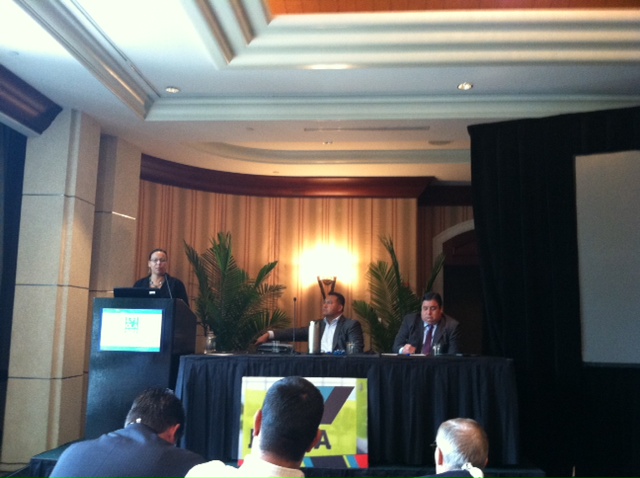
Today, Gabe Galanda addressed the Native American Financial Services Association (NAFSA), in a presentation titled, "A Quick History Lesson: Foundational Elements of Tribal Sovereignty, Tribal Self-Governance and the Government to Government Mandate." He delivered his remarks (slides here) at the Tribal Government Online Lending Symposium Presented by the Online Lending Association and NAFSA. Gabe specifically discussed notions of inherent sovereignty and preemptive consultation as means of countervailing federal and state attacks against tribal online lending activities.

Gabriel "Gabe" Galanda is a partner at Galanda Broadman PLLC, of Seattle, an American Indian owned law firm.  He is an enrolled member of the Round Valley Indian Tribes of Covelo, California.  Gabe assists tribal governments and businesses in all matters of tribal economic development and diversification, including entity formation and related tax strategy. He also helps tribes and tribal businesses and joint ventures withstand attack from federal, state and local government. Gabe can be reached at 206.691.3631 or gabe@galandabroadman.com.

Gabe Galanda Republishes Tribal Economic Diversification Paper

Gabe Galanda published an updated version of his paper, "The Business Case for Private Investmentand Development in Indian Country," at the 12th Annual Native Nations Law Symposium that was held on the Kickapoo Reservation in Kansas on September 14th. He added new topics such as several federal Indian Country tax incentives that Congress has allowed to expire, as well as the HEARTH Act. He originally published the paper at RES 2011, at the request of the U.S. Department of the Interior's Office of Indian Energy and Economic Development.

[W]hile state and local governments struggle to make ends meet [amidst the Great Recession], tribal governments have largely avoided economic catastrophe. Fueled by the $26 billion Indian gaming industry, Indian Country is generally faring much better than neighboring local economies since the recession took hold in 2008. Ironically, not having property tax bases to begin with, most tribal governmental revenues have remained stable. Many tribes are avoiding complacency; they recognize that the Indian gaming industry will not sustain its exponential growth over the last decade. The inevitable legalization of Internet gaming and, in some jurisdictions, commercial land-based gaming, will eventually put a major dent in Indian Country’s bottom line. As such, tribal governments are more than ever looking to diversify their economies.

Where tribes bring a staggering array tangibles like land and location, and intangibles like sovereignty, relaxed red tape and tax exemption, their corporate business partners bring proven industry expertise and new capital to the reservation. Whether through a joint venture between a tribe and a non-Indian business, a tribal land lease to a non-tribal company, or a tax credit investment – all of which are contemplated below – there are an abundance of very advantageous reservation development deals for Corporate America to symbiotically explore with tribes at this time in our nation’s history. The time is now for tribes to leverage these advantages to create new economic and job opportunities on their reservations.

Gabriel "Gabe" Galanda is a partner at Galanda Broadman PLLC, of Seattle, an American Indian owned law firm.  He is an enrolled member of the Round Valley Indian Tribes of Covelo, California.  Gabe assists tribal governments and businesses in all matters of tribal economic development and diversification, including entity formation and related tax strategy. Gabe can be reached at 206.691.3631 or gabe@galandabroadman.com.

Ryan Dreveskracht Warns Indian Country About the STOP Act

Today, Ryan Dreveskracht spoke about the disastrous implications for Indian Country associated with the STOP Act, at the "Knowledge is Power! 2012 Tribal Tobacco Tax Training and Seminar" sponsored by HCI Distribution at WinnaVegas Casino Resort located in Sloan, Iowa. His PowerPoint slides can be downloaded here.

Ryan Dreveskracht is an Associate at Galanda Broadman PLLC, of Seattle, an American Indian majority-owned law firm. His practice focuses on representing businesses and tribal governments in public affairs, energy, gaming, taxation, and general economic development. He can be reached at 206.909.3842 or ryan@galandabroadman.com.

Federal Indian Country Tax Incentives Expire

Amidst partisan gridlock in the Beltway over national tax policy, Congress has allowed several tax incentives designed to attract private development and jobs to Indian Country, to expire. Others will expire unless Congress acts. Indeed, amidst much election-year debate about the American small business sector and middle class, Indian Country's private sector and hope for a robust middle class has been forgotten by Congress.

-- The accelerated depreciation program, which allows manufacturers with facilities in Indian Country to use shorter recovery periods when calculating depreciation deductions for production equipment, has been unavailable since January 1, 2012. Legislation has been introduced that would reauthorize the provision until 2014. S. 3521, 112th Cong. § 211 (2012); H.R. 6240, 112th Cong. § 201 (2012).

-- The Indian Employment Tax Credit, which provides businesses with an incentive to hire individuals who are enrolled members of an Indian tribe (or the spouse of an enrolled member) and who live on or near an Indian reservation, expired on December 31, 2011. Legislation has been introduced that would retroactively extend the program to December 31, 2013. S. 3521, 112th Cong. § 204 (2012).

-- The Low-Income Housing Tax Credit Program, through which tax credits are available for low-income housing projects on homes that that were constructed, rehabilitated or acquired since 1986, including those in Indian Country, are currently available to until only September 30, 2011. Legislation has been introduced to extend the credits to January 1, 2014. S. 3521, 112th Cong. § 203 (2012).

-- The Work Opportunity Tax Credit, a federal tax credit incentive for private-sector businesses that hire individuals from twelve target groups who have consistently faced significant barriers to employment, including certain Indians, expired in 2011. Legislation has been introduced that would extend the WOTC to December 31, 2013. S. 3521, 112th Cong. § 209 (2012).

Indian Country must urge that these tax incentives be extended so that tribal governments can continue to attract private capital and create new jobs for tribal members and neighboring communities. Between now and November any calls to Capitol Hill will likely fall on deaf ears. But come after the election, tribal constituents should call their Delegation to urge that Indian Country's tax and job needs not be forgotten.

Gabriel "Gabe" Galanda is a partner at Galanda Broadman PLLC, of Seattle, an American Indian owned law firm.  He is an enrolled member of the Round Valley Indian Tribes of Covelo, California.  Gabe assists tribal governments and businesses in all matters of tribal economic development and diversification, including entity formation and related tax strategy. Gabe can be reached at 206.691.3631 or gabe@galandabroadman.com.

Anthony Broadman Co-Chairs Annual Ad Law Conference

Anthony Broadman, the current Chair of the WSBA Administrative Law Section, will co-chair, the "Advocacy in Administrative Law" conference in Seattle on October 24, 2012. Earlier this year, he published a chapter, "Administrative Law in Washington State Indian Country" in the Section’s Washington Administrative Practice Manual -- an authoritative text on administrative law in Washington Indian Country.

Anthony Broadman is a partner at Galanda Broadman PLLC. He can be reached at 206.321.2672, anthony@galandabroadman.com, or via www.galandabroadman.com.

Indian Civil Rights Lawyers

We represent Indians and others in civil rights matters, especially against the United States, state government and private entities. Our experience includes:

-- Suing the United States pursuant to the Administrative Procedures Act (APA) for violation of Indian Treaty, land and related civil rights.

-- Suing the United States pursuant to the Federal Tort Claims Act (FTCA) for claims resulting from tortuous acts or omissions arising from self-governance or "638" contractual functions.

-- Suing federal, state, county and city police officers for Section 1983 and other claims related to excessive use of force and other forms of racial discrimination and retaliation against Indians.

-- Suing public and private health care providers for discriminating against Native Americans.

-- Suing public and private defendants for the wrongful death of or serious injury to Native Americans.

-- Suing public and private employers for racial, religious and other discrimination against Indians.

If you or a loved one's civil rights have been violated, call us.

Washington Supremes: Attack On Tribal Gas Stations Can Continue

The Washington State Supreme Court held 5-4 today that AUTO’s lawsuit attacking Tribe-State Fuel Tax Agreements can move forward. The majority found that Tribes are not indispensable parties to the lawsuit. Plainly, this means that the suit can proceed and that for now the Washington Automotive United Trades Organization (AUTO) can continue to attack Tribal governments through a lawsuit against the state.

At the core of its lawsuit, AUTO argues that the state, Governor Christine Gregoire, and the state Department of Licensing are violating the Washington Constitution by entering into the fuel compacts with Tribes and that the legislative system surrounding the compacts itself is illegal.

The decision, AUTO I, was decided on procedural grounds. But like most procedural decisions employing balancing tests, judges can rationalize reversal or affirmation. As the majority itself pointed out: “As with all equitable standards, the proper application of CR 19(b) involves a careful exercise of discretion and defies mechanical application.” Which means that judges can justify whatever result they desire.

But the anti-tribal/state majority did make some helpful intermediate findings: First, the tribes are necessary parties. As a matter of civil procedure, parties are necessary when they claim a protected interest in a lawsuit. The majority held that the tribes’ interests in the fuel tax regime are both profound and not adequately represented by the state. If AUTO wins, tribes lose big.

Second, the majority soundly endorsed the continuing sovereign immunity of tribes. Justice Stephens offered the following nuanced discussion, without citation, of tribes’ ability to manage their own immunity from suit:

In fact, an Indian tribe may cabin the extent of its waiver. The greater power to remain utterly immune from suit encompasses the lesser power to consent to suit only on a particular claim or in a particular forum or by a particular party. Sovereign immunity is not an all or nothing proposition, and a narrow waiver does not destroy immunity for all purposes.

So far so good. But on indispensability itself, the Court showed its colors, achieving the result it wanted at the cost of bad legal analysis. Indispensability (after necessity and inability to join have been decided) asks whether the case can proceed “in equity and good conscience” without the absent party in light of four factors.

Analyzing the first factor, prejudice to the tribes, the Court held that the tribes would be severely prejudiced. As the majority noted, “[t]his first factor strongly favors dismissal.” Usually, with immune parties, this is the end of the discussion. This has certainly been the historic approach of Washington Courts.

The second factor is whether the Court can fashion relief to reduce such prejudice. The Court recognized that because AUTO’s solution – suing tribal officials who signed the fuel tax agreements – was as bad as the prejudice, “the second CR 19(b) factor favors dismissal.” The Court did not even really apply the third factor (adequacy of judgment without the tribes) but found that it counseled for dismissal anyway. If you’re keeping score, that’s three factors for dismissal, and zero factors against it.

Relying then completely on the fourth factor, the absence of remedy upon dismissal, the Court held that because “there appears to be no other judicial forum in which plaintiffs can seek relief, the plaintiff lacks an adequate remedy in the event of dismissal,” the case could not be dismissed.

In the end, even though the Court has dismissed similar suits over somewhat similar agreements on indispensability grounds, the state, and indirectly, the tribes, were before the wrong justices. The Court naively noted that, “Sovereign immunity is meant to be raised as a shield by the tribe, not wielded as a sword by the State.” But as is clear in this case, if courts force cases forward with indispensible parties, it’s a shield that immune parties can’t even employ without waiving.

Here is the updated rough chart of Washington State Supreme Court voting tendencies:
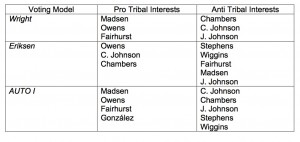
In Wright and AUTO, which are the most analogous cases, only justices Madsen, Owens, and Fairhurst have come down on Tribal side of cases (justices González and Stephens were not on the Court for Wright.) The other end of the Court has congealed around both justices Johnson and Justice Chambers, and promises to be consistently resistant to protecting tribal interests.
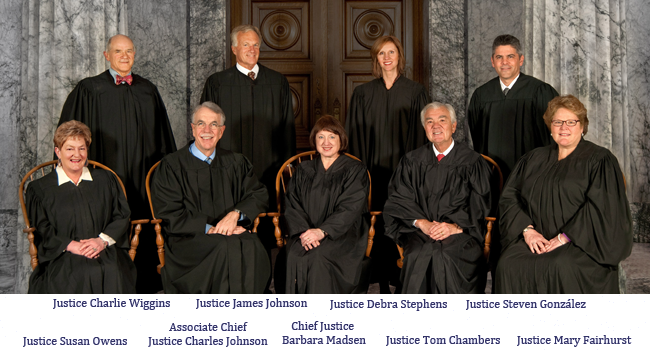
We’re calling it AUTO Part One because Part Two will come, whether through review to the U.S. Supreme Court or through further litigation in the Washington State Courts. Either way, AUTO promises to carry even more profound risks to the Tribal-State fuel tax regime, and indirectly to the sovereignty of Washington tribes themselves.

Anthony Broadman is a partner at Galanda Broadman PLLC. He can be reached at 206.321.2672, anthony@galandabroadman.com, or via www.galandabroadman.com.

State-Tribal Consultation Right Crystallizing

Last week, the United Nations Special Rapporteur on the Rights of Indigenous Peoples, James Anaya, urged “local and state authorities in South Dakota” to address concerns expressed by the Sioux Nations regarding the impending private land sale of Pe’Sla, a sacred site of the Lakota, Dakota and Nakota Peoples, in the Black Hills. While the federal Indian consultation right is now entrenched in federal law, the Special Rapporteur’s pronouncement of a state-tribal consultation right is profound. 

The Special Rapporteur’s proclamation follows a Resolution passed by the National Congress of American Indians in March 2011, whereby NCAI resolved that much like the United States’ consultation obligations to tribes, “states and local governments [must] meaningfully consult with tribal governments, on a government-to-government basis, regarding any matter of tribal implication, in order to allow any affected tribal government to express its views and assert its rights in advance of any non-tribal governmental action or decision-making.”

Indeed, much like the international norm of indigenous consultation and the federal Indian consultation right have each crystallized through non-tribal governmental actions and proclamations, a state-tribal consultation right is forming.

Gabriel "Gabe" Galanda is a partner at Galanda Broadman PLLC, of Seattle, an American Indian owned law firm.  He is an enrolled member of the Round Valley Indian Tribes of Covelo, California.  Gabe is currently writing a piece for Indian Country Today, tentatively titled, "Developing and Enforcing the State-Tribal Consultation Right." He can be reached at 206.691.3631 or gabe@galandabroadman.com.

Training Seminar for Tribal and Federal Law Enforcement: A Good First Step

Topics included law enforcement response, children as victims and witnesses, forensic examinations with adult victims and, most importantly, developing a coordinated and consultative community response to sexual assault.  Such consultation is mandated by various sections of the Tribal Law and Order Act of 2010, Pub. L. No. 111-211, which instructs that that federal law enforcement consult, cooperate, and coordinate with tribal law enforcement.  Some federal agents on the ground in Indian Country, however, have chosen to ignore this mandate.  Hopefully, the training seminar will begin to facilitate the fulfillment of the TLOA.  More than 75 persons, including representative from 23 tribal governments, participated in the three-day training course.


Ryan Dreveskracht's "Revictimizing Native Women for Political Purposes" Goes Viral

Ryan Dreveskracht's commentary, "Revictimizing Native Women for Political Purposes," regarding the increasingly partisan and misogynist VAWA reauthorization debate, was originally published on Crosscut. His op-ed has since been reposted by Turtle Talk, Indian Country Today Media Network, and pechanga.net, and has in turn gone viral via tribal social media.

As originally passed by the U.S. Senate, the Violence Against Women Act reauthorization legislation would allow tribes to exercise limited criminal jurisdiction over certain non-Indians who violate Native American women on Indian reservations. Tribes would be required to provide all rights accorded to defendants in state and federal court, and federal courts would have authority to review tribal court decisions that result in incarceration. The legislation would not raise the one-year maximum sentence that tribal courts can impose. The GOP-controlled House, however, omitted the protections for Indian women in its version of the bill.

Among those voting to omit the tribal protections were vice presidential candidate Paul Ryan, U.S. Senate candidate Akin, and House Republican King. In an interview originally broadcast on Sunday, Akin suggested that an abortion would be unnecessary in the instance of a “legitimate rape” because apparently only non-legitimate rape leads to pregnancy — whatever that means. Chiming in agreement, fellow House Rep. King said that he’s never heard of a girl getting pregnant from statutory rape or incest. While Akin and King quickly recanted, they cannot as simply withdraw their votes against the Senate’s proposed protections for abused Native women.

Also Monday, the News Tribune (editorial, “Protect Indian women without diluting Bill of Rights”) accused tribal governments of having “an agenda of their own: They see the domestic violence issue as a way to assert and reclaim broader sovereign powers.” The editorial is wrong. Indian country sees the the Violence Against Women Act (VAWA) reauthorization as a way to protect Indian women from being violently assaulted.

Ryan Dreveskracht is an Associate at Galanda Broadman PLLC, of Seattle, an American Indian majority-owned law firm. His practice focuses on representing businesses and tribal governments in public affairs, energy, gaming, taxation, and general economic development. He can be reached at 206.909.3842 or ryan@galandabroadman.com.