In Historic Statement, BIA Pledges to Safeguard Indigenous Individuals' Rights

A weekend USA Today news feature regarding the United States’ recent intercession in the Nooksack housing rights calamity (.pdf here), includes the following historic statement from the BIA:

The federal government must protect the rights of individuals under federal law, including the Indian Civil Rights Act... BIA respects tribal sovereignty and supports tribal self-determination. Accordingly, we seek to work closely with our tribal partners to safeguard the rights of both tribes and individuals.

The BIA’s statement marks the second time the Biden administration has professed a commitment to protecting Indigenous individuals’ human rights from violation by Tribal governments, and a break from modern administrations that focused almost exclusively on supporting Tribal self-determination rights.

USA Today also highlights HUD “Secretary Marcia Fudge's October statement encouraging four Oklahoma tribes to accept descendants of Freedmen who once had been enslaved by the tribes.” Secretary Fudge consulted with Interior before making that statement.

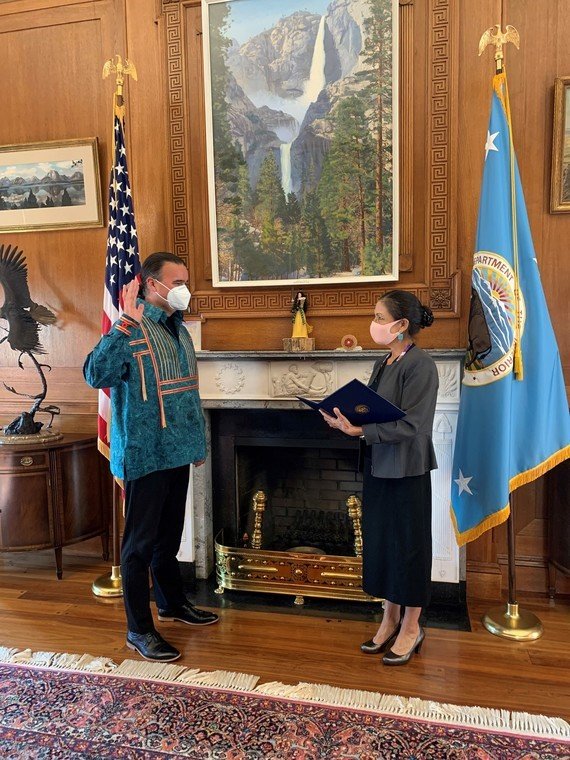
Neither statement would have been issued without the guidance and support of Interior Secretary Deb Haaland or Assistant Secretary—Indian Affairs Bryan Newland. Indigenous representation does matter.

Both the BIA and HUD statements represent historic commitments by the United States to protect Indigenous individuals from domestic human rights abuse by Tribal governments. Both statements reflect the Trustee’s common-law moral trust responsibility to Tribal citizens and descendants. Both statements recognize that in the context of Indigenous human rights, Tribal sovereignty and self-determination are not absolute.

As explained by USA Today:

Galanda, a Seattle lawyer and member of the Round Valley Indian Tribes of California, said earlier Supreme Court decisions call for federal intervention under a "moral trust responsibility."

"The tension lies between tribal self-determination and Indigenous human rights protection in the form of federal diplomatic intercession," he said. "I think there have to be scenarios in which the Indigenous human rights violation is so atrocious and so threatening to an Indigenous community's existence that the (U.S. government) must exercise its moral trust responsibility."

I wholeheartedly applaud the Biden administration, particularly Secretary Haaland and ASIA Newland, for boldly professing a commitment to safeguard Indigenous individuals’ human rights.

Gabe Galanda is an Indigenous rights attorney and the managing lawyer at Galanda Broadman in Seattle. He belongs to the Round Valley Indian Tribes of California, descending from the Nomlaki and Concow Peoples.

The Nooksack 306: "We still belong at Nooksack. We will always belong at Nooksack."

Guest Column By The Nooksack 306

Who are we—the Nooksack 306?

We are 306 Nooksack Indigenous relatives who have faced persecution by politicians running the Nooksack Indian Tribe in Whatcom County of Washington State, since 2012.

While Nooksack politicians claim we were telephonically disenrolled in November 2016, the U.S. Interior Department invalidated the disenrollment that month and U.S. Department of Justice later declared that those politicians "endeavored to unilaterally declare members of this minority group 'disenrolled' using a sham hearing process while also systematically depriving them of the means to challenge the actions . . . in the tribal judicial system." We were also disenrolled despite several Nooksack tribal court injunction orders.

We have never been legally disenrolled. We still belong at Nooksack. We will always belong at Nooksack.

What is disenrollment and why is it destructive?

Disenrollment is a non-traditional, neocolonial tribal practice that is intended to keep tribal politicians in power and concentrate a tribe's wealth within their political base by removing enrolled citizens of their tribal nations who are seen as a "threat" to said power and wealth hoarding. This would be equivalent to the United States revoking your American citizenship because a political leader feels they can gain more power if you don't have rights. Read more about how disenrollment is problematic by clicking here.

Are we the only Indigenous peoples experiencing disenrollment?

No.  There are over 90 U.S.-recognized tribes (15% of all recognized tribes) who have disenrolled as many as 10,000 tribal citizens for power and profit. Disenrollment is allowed to occur because federal and state courts will generally not assert jurisdiction over the deprivation of an Indigenous person's civil rights. As at Nooksack, tribal courts are often beholden to the politicians who are causing the persecution and disenrollment. 

Why are we being persecuted?
Nooksack politicians argue that our ancestor, Annie George, is not Nooksack and her daughters were wrongly enrolled.  Annie George is the daughter of Matsqui, the Chief of the Nooksack Village of Matsqui in British Columbia. The Tribe recognizes Matsqui as a “Nooksack Place Name” in our traditional language Lhéchalosem on its website

Nooksack people hail from southern British Columbia and northern Washington State.  A Nooksack chief signed a U.S. Indian Treaty in 1855 but the courts treated us as Canadian Indigenous persons until 1973, when the Tribe was recognized by the U.S.  Our Elders were enrolled in the 1980s. Disenrollment came 40 years later after individuals outside the George lineage felt we were a threat to their political power.

In 2013, Tribal politicians launched a successful political campaign to amend Nooksack constitution in order to eliminate us. They also fired the Chief Judge of the Nooksack Tribal Court who had ruled against them, and installed their white lawyer Ray Dodge as the new Chief Judge to make sure no lawsuit we might file in Tribal Court to prevent our disenrollment would ever be heard.

We are believed to be one of the largest Indigenous families ever subject to disenrollment in the United States. To learn more about our disenrollment, please read this article by The New York Times.  

What issues do we face as disenrolled Indigenous peoples?

Without enrollment, we are denied access to voting, health services, fishing rights, pensions, and scholarship opportunities. We cannot take part in cultural or political activities at Nooksack. Our disenrollment has also led to 63 of us facing eviction from our homes that we own under federally funded home ownership programs.

What changes do we hope to see happen?

We hope that Nooksack politicians will do the right thing and stop this decade-long injustice. If they continue to refuse, we hope that - with our attorney Gabe Galanda - the federal government will determine this to be a civil rights violation. We have also called upon the United Nations to declare this an international human rights atrocity.  We hope that the deprivation of any Indigenous person's civil rights will be prevented.

What can outsiders do to support us?

Allies are invited to follow our Twitter (@Nooksack306) and Facebook (The Nooksack 306). Sharing and retweeting our content helps others learn about us and creates further pressure on the Nooksack tribal government to do the right thing. We also ask for donations to our GoFundMe to support the 63 of us who are being evicted from our homes at Nooksack.


Matt Slovin Explains Cardrooms' New Suit Against Washington Tribal Sports Betting

Maverick Gaming LLC, the owner-operator of 19 Washington cardrooms, sued state and federal officials in D.C. federal court Tuesday, alleging violations of the Indian Gaming Regulatory Act (“IGRA”) and equal protection.

Specifically, Maverick argues that the State of Washington’s gaming compacts illegally give tribes a monopoly over roulette, craps, and sports betting—forms of what IGRA refers to as “class III gaming.” In 2021, the State and 16 tribes amended their compacts to authorize sports betting.

IGRA permits tribes to engage in class III gaming only if “such activities are . . . located in a State that permits such gaming for any purpose by any person, organization, or entity, and conducted in conformance with a Tribal-State compact entered into by the Indian tribe and the State . . . that is in effect.”

The crux of Maverick’s argument is that tribes cannot engage in roulette, craps, and sports betting because: (1) Washington does not “permit[] such gaming . . . by any person, organization, or entity” as non-tribal actors cannot participate; and (2) the compact amendments permitting sports betting violate IGRA and other federal law.

 Whether Class III Gaming by Washington Tribes Violates IGRA Because the State Does Not “permit[] such gaming . . . by any person, organization, or entity”

Maverick’s first argument is that the tribes’ “monopoly” on roulette, craps, and sports betting violates IGRA because Washington does not “permit[] such gaming . . . by any person, organization, or entity.” 25 U.S.C. § 2710(d)(1)(B).

Washington law allows tribes to compact to conduct sports wagering. See RCW 9.46.0364. But Maverick alleges that the State criminally prohibits non-tribal entities from participating in sports wagering.

Courts have applied different tests in determining whether certain state gaming activities violate IGRA.

In interpreting § 2710(d)(1)(B), the Eighth Circuit Court of Appeals asked whether state “gaming law is prohibitory or regulatory in nature.” U.S. v. Sisseton-Wahpeton Sioux Tribe, 897 F.2d 358, 366 (8th Cir. 1990). If state law prohibits “gambling in general” and the particular activity in question, it violates IGRA to allow a tribe to participate in it. Id. at 368. But if state law merely regulates gambling and the specific activity, there is no IGRA violation. Id. The Second Circuit Court of Appeals has adopted the same test. See Mashantucket Pequot Tribe v. State of Conn., 913 F.2d 1024, 1032 (2d Cir. 1990).

However, the Ninth Circuit Court of Appeals found the statute ambiguous and resolved the ambiguity in favor of tribes under a canon of construction. See Artichoke Joe’s California Grand Casino v. Norton, 353 F.3d 712, 731 (9th Cir. 2003). Thus, the Ninth Circuit held that a state “permits” class III gaming under IGRA even if those activities are only legalized for tribes. Id.

If the U.S. District Court for the District of Columbia adopts the prohibition-regulation dichotomy here, it is possible a judge would find sports betting by tribes in Washington violates IGRA; Maverick has pointed to state law that it reads as prohibiting class III gaming by non-tribal entities. See RCW 9.46.222.

Whether the Compact Amendments Allowing Sports Betting Violate IGRA and Other Federal Law

Maverick alleges the Secretary of the Interior was obligated to disapprove the 2021 compact amendments, which allow tribes to engage in sports betting, for three reasons.

First, as discussed above, Maverick argues the amendments violate IGRA because they purport to authorize class III gaming in a state—Washington—that does not allow non-tribal actors to participate.

Second, Maverick argues the amendments run afoul of the Constitution’s equal protection guarantee through discrimination on the basis of race and ancestry.

Third, Maverick argues that the compact amendments violate the Tenth Amendment because the federal government, through IGRA, required states to negotiate compacts with tribes.

Through the lawsuit, Maverick seeks an order declaring that the compacts and compact amendments violate IGRA, the equal protection clause, the Tenth Amendment, and other federal law.

Matt Slovin is an Associate with Galanda Broadman PLLC. and Harvard Law School graduate. He is a former sports reporter, for MLB.com and The (Nashville) Tennessean.

Governor Inslee Appoints Ryan Dreveskracht to State Criminal Justice Training Commission

On December 14, 2021, Governor Inslee appointed Ryan Dreveskracht to serve as the a Board Member on the Washington State Criminal Justice Training Commission (“CJTC”).

The CJTC was created in 1974 to establish standards and provide training to criminal justice professionals, including peace officers, local corrections officer and to certify, and when necessary de-certify, peace officers. Washington State is one of only a few states that not only establishes training standards, but also provides Basic Training for Peace Officers and Corrections Officers. This unique model ensures that every local officer has consistent and high quality training guided by the CJTC.

On the CJTC Board, Ryan will preside over law enforcement practices and accountability, as provided in RCW 43.101.030(1)(f).

Ryan Dreveskracht is an attorney with Galanda Broadman, PLLC, in Seattle. His practice includes civil rights and wrongful death litigation. He can be reached at (206) 909-3842 or ryan@galandabroadman.com.

Gabe Galanda, Anthony Broadman to Co-Chair 19th Annual Northwest Gaming Law Summit

Gabe Galanda and Anthony Broadman will co-chair the 19th Annual Northwest Gaming Law Summit at the Washington Athletic Club in Seattle on December 9 and 10, 2021.

The Summit, which remains the most important gaming legal education event in the country, attracts a veritable “who’s who” in the tribal and commercial gaming industries.

Agenda For Thursday, December 9, 2021

9:00 PDT

INTRODUCTION AND OVERVIEW

Anthony S. Broadman, Program Co-Chair
Galanda Broadman PLLC

Gabriel S. Galanda, Program Co-Chair
Galanda Broadman PLLC

David A. Malone, Program Co-Chair
(Live, via Webcast)
Miller Malone & Tellefson

9:10

NATIONAL INDIAN GAMING LITIGATION UPDATE

Review of the major cases decided over the past year regarding the interpretation and implementation of the Indian Gaming Regulatory Act and tribal/state compacts governing tribal gaming operations.

Scott D. Crowell
Crowell Law Office – Tribal Advocacy Group PLLC

9:45

INDIAN GAMING FEDERAL LEGISLATIVE UPDATE

Review of major federal legislative and policy developments over the last year that impact tribal governments and gaming enterprises.

Joshua Clause
Clause Law PLLC

Aurene M. Martin, President
Spirit Rock Consulting, Inc.

10:45

BREAK

11:00

NORTHWEST GAMING STATE LEGISLATIVE UPDATE

Review of major Washington and Oregon state legislative and policy developments over the last year that impact tribal governments and gaming enterprises.

Anthony S. Broadman, Moderator
Galanda Broadman PLLC

Rebecca George, Executive Director
Washington Indian Gaming Association

Justin Martin
Perseverance Strategies, Inc.

Anna Richter Taylor
(Live, via Webcast)
ART Public Affairs

12:15

MIDDAY BREAK

1:30

SECTION 20 LITIGATION & ADMINISTRATIVE UPDATE

Review of cases decided over the past year regarding the interpretation and implementation of Section 20 of the Indian Gaming Regulatory Act.

John A. Maier
Maier Pfeffer Kim Geary & Cohen LLP

Scott Wheat
Wheat Law Offices

2:30

SPECIAL KEYNOTE PRESENTATION: THE STATE OF FEDERAL/TRIBAL GAMING RELATIONS

Update on the Department of the Interior's Federal policy agenda for Indian Country

Bryan Newland, Assistant Secretary
Indian Affairs, U.S. Department of the Interior

3:00

BREAK

3:15

SPECIAL KEYNOTE PRESENTATION: INDIAN GAMING IN 2022

Ernest L. Stevens, Jr., Chairman
National Indian Gaming Association

3:45

INDIAN GAMING POST-PANDEMIC: TRIBAL EXECUTIVE INSIGHTS

Review of how tribal governments and gaming enterprises have responded to the COVID-19 pandemic and adapted for the future.

Rebecca George, Executive Director, Moderator
Washington Indian Gaming Association

Hon. W. Ron Allen, Chairman
Washington Indian Gaming Association

Junior Maldonado, Executive Director
Gaming Operations, Muckleshoot Casino Resort

Laura Penney, Chief Executive Officer
Coeur d’Alene Casino Resort Hotel

5:00

ADJOURN

Agenda For Friday, December 10, 2021

9:00 PDT

INTRODUCTION AND OVERVIEW

Anthony S. Broadman, Program Co-Chair
Galanda Broadman PLLC

Gabriel S. Galanda, Program Co-Chair
Galanda Broadman PLLC

David A. Malone, Program Co-Chair
(Live, via Webcast)
Miller Malone & Tellefson

9:10

SPORTS COMPACT LITIGATION

Review of a recent Florida case and discussion of the potential future application of the Florida model in the Pacific Northwest.

David A. Malone, Moderator
(Live, via Webcast)
Miller Malone & Tellefson

Marc W. Dunbar
(Live, via Webcast)
Dean Mead
Tallahassee, FL

Robert M. Jarvis
(Live, via Webcast)
Professor of Law
Nova Southeastern University
Fort Lauderdale, FL

10:15

BREAK

10:30

SPORTS BETTING – A PANEL DISCUSSION

Review of “brick and mortar” models such as Washington State’s new compact amendments; “mobile” models as in Florida and Colorado; state law-based models as in Michigan, Arizona and Connecticut, and California’s competing ballot measures.

Scott Wheat, Moderator
Wheat Law Offices

Steve M. Bodmer, General Counsel
Pechanga Band of Luiseño Indians

Scott D. Crowell
Crowell Law Office – Tribal Advocacy Group PLLC

Christine M. Masse
Miller Nash LLP

12:00

ADJOURN

Matt Slovin Named to Harvard Law School Alumni Board

Matt Slovin, an Associate for Galanda Broadman PLLC, was recently named to the Executive Board of the Harvard Law School Association's Recent Graduates Network.

The Recent Graduates Network helps to keep those who graduated in the past 10 years connected to the school and its affiliates.

Slovin is a 2019 graduate of Harvard Law School. He will serve a two-year term as co-communications chair.

Matt Slovin is an Associate at Galanda Broadman, PLLC, an Indigenous rights law firm. His practice focuses on Indian civil rights litigation, as well as cases involving tribal governments and enterprises.

Federal Infrastructure Bill Provides $3 Billion for Tribal Transportation

By Matt Slovin

The Infrastructure Investment and Jobs Act (IIJA), which President Joe Biden signed into law on November 15, authorizes approximately $3 billion in spending for the tribal transportation program over the next five fiscal years.

 Under the pre-existing tribal transportation program, the federal government maintains a “comprehensive national inventory of tribal transportation facilities that are eligible for assistance.” 23 U.S.C. § 202(b)(1)(A). The program’s purpose is “to provide safe and adequate transportation and public road access to and within Indian reservations, Indian lands, and Alaska Native Village communities.” See U.S. Department of Transportation, Office of Tribal Transportation, https://highways.dot.gov/federal-lands/programs-tribal.

Of the $3 billion in tribal transportation spending, $100 million is allocated toward tribal transportation facility bridges. An additional $825 million is available under the same program in supplemental appropriations. Under Section 14004 of the IIJA, the bridge-specific funds are to be used:

(1) to carry out any planning, design, engineering, pre-construction, construction, and inspection of new or replacement tribal transportation facility bridges;

(2) to replace, rehabilitate seismically retrofit, paint, apply calcium magnesium acetate, sodium acetate/formate, or other environmentally acceptable, minimally corrosive anti-icing and deicing composition; or

(3) to implement any countermeasure for tribal transportation facility bridges classified as in poor condition, having a low load capacity, or needing geometric improvements, including multiple-pipe culverts.

Under the new law, the Bureau of Indian Affairs will receive a $270 million appropriation for its road maintenance program. The IIJA also raises the percentage of tribal transportation funds available to tribal governments applying for highway safety improvement projects from 2 to 4 percent.

The new law sets aside $9 million of the tribal transportation dollars to carry out the Tribal High Priority Projects Program, which helps repair or reconstruct eligible tribal transportation facilities. The IIJA also contains a separate, $30 million annual appropriation toward the Tribal High Priority Projects Program.   

The IIJA creates the Office of Tribal Government Affairs within the Department of Transportation, to be led by an Assistant Secretary for Tribal Government Affairs. It also contemplates a consultation process between the Secretary of Transportation, Indian tribes, Alaska Native villages, and state transportation departments to develop best practices for sharing and analyzing on-reservation crash data, as well as to create a standardized form to implement those best practices.

Finally, the IIJA requires the Secretary of Transportation to allocate at least one seat on a newly formed working group on covered transportation resources to tribal governments.

Matt Slovin is an Associate at Galanda Broadman, PLLC, an Indigenous rights law firm. His practice focuses on Indian civil rights litigation, as well as cases involving tribal governments and enterprises.

Galanda Broadman Named "Best Firm" in Native American & Gaming Law for Tenth Year

Galanda Broadman, PLLC, has been named a “Best Law Firm” by U.S. News - Best Lawyers in the arena of Native American Law and Gaming Law, for the tenth year in a row. 

According to U.S. News - Best Lawyers, the firm's national ranking was determined through the firm's overall evaluation, which was derived from a combination of Galanda Broadman’s “clients' impressive feedback” and “the high regard that lawyers in other firms in the same practice area have for [the] firm.” 

Galanda Broadman is dedicated to advancing Indigenous legal rights and business interests and defending Indigenous human rights.

The firm, with nine lawyers and offices in Seattle and Yakima, Washington and Bend, Oregon, represents Indigenous governments, businesses, and citizens in critical litigation, business and regulatory matters—especially in matters of Treaty rights, sovereignty, taxation, civil rights, and belonging.

Nooksack Judges Dodge, Majumdar Assert New Info For Bad Faith Appeal

107732053_291205471994356_5016783191912199104_n.jpg

Law360 (October 15, 2021, 8:07 PM EDT) -- Two Nooksack tribal court judges and a former Nooksack citizen who accused them of persecuting her while she sought protection from domestic abuse are vying in the Ninth Circuit over whether the appellate panel should consider new information.

Elile Adams, who renounced her Nooksack citizenship, brought bad faith claims alleging an illegitimate tribal court persecuted her through child custody proceedings after she sought protection from domestic abuse, and is appealing a Washington federal judge's decision that tribal courts have jurisdiction over her criminal proceedings, which she says are politically motivated.

The underlying dispute is a spillover from a yearslong controversy over tribal officials allegedly conspiring to disenroll members who disagreed with their leadership.

Tribal court judges Raymond D. Dodge and Rajeev Majumdar are trying to get the Ninth Circuit panel to consider documents from Rabang v. Kelly — a suit the appellate court heard about the disenrollment dispute.

Nooksack Chief Judge Ray Dodge

Nooksack Chief Judge Ray Dodge

Past Washington Sate Bar Association President & Nooksack Pro Tem Judge Rajeev Majumdar

Past Washington Sate Bar Association President & Nooksack Pro Tem Judge Rajeev Majumdar

They wrote in a Wednesday reply supporting their request for judicial notice of the documents that their motion does not pertain to the allegations of Rabang v. Kelly and instead quashes claims that Judge Dodge was illegitimately appointed to his position.

"Adams's argument that the materials submitted are not relevant are belied by the fact that she makes several references in her opening brief with respect to the legitimacy of Judge Dodge's appointment," the judges wrote.

"Indeed, it is for that reason that the judges have been forced to submit these additional materials for judicial notice. In her brief, Adams paints an incomplete and inaccurate picture of the events related to the United States' brief period of non-recognition of the tribe," they added.

Gabriel S. Galanda of Galanda Broadman PLLC told Law360 in a phone interview Friday evening that this judicial notice dispute was created as "an optical illusion and distraction" from Adams' bad faith claims against the tribal court.

"If they had a strong defense to the bad faith claims, they would have brought it, but they don't — they cannot contest and do not contest the central allegations underlying the bad faith claims, so they create confusion and misdirection," Galanda said.

"She sought domestic violence protection in 2017, and Ray Dodge converted that plea for domestic violence protection into a child custody proceeding — threatening the custody of her child — which should be unthinkable. But because that is so egregious and because the bad faith is so obvious here, they're trying to confuse the court by throwing a bunch of extraneous information to the court," he added.

Adams argued last week against allowing judicial notice of the first amended complaint in Rabang v. Kelly and sworn declarations by tribal attorneys, claiming the judges "inappropriately seek a do-over" of developing their side.

"Any tribal 'ratification' of Dodge's appointment in early 2016 does not negate his and the Nooksack Tribal Court's bad faith from March of 2017 to present. Nor does that material have any bearing whatsoever on whether the Nooksack Tribe plainly lacks criminal jurisdiction over Ms. Adams," she wrote in an opposition response.

"In any event, relevancy is not the proper standard for determining whether judicial notice is appropriate. Such a rule would open the floodgates," she added.

Adams said in her Washington federal court complaint in 2019 that the dispute dates to 2012, when she and her father — a spokesperson for the hundreds of people who faced tribal disenrollment — openly critiqued Nooksack tribal officers, dubbed councilpersons, who wanted to disenroll them.

Unrelated to the political feud, Adams encountered a variety of legal disputes with the father of her child over several years, which ultimately led to her obtaining a protection order against him issued by Judge Dodge in March 2017.

Later that month, Judge Dodge decided sua sponte — of his own accord — to issue a parenting order against Adams, which she claimed in her complaint was to "endlessly harass" her. She also alleged that he lacked authority to conduct these proceedings, yet forced her to appear before him 18 times over two years "through an abuse of judicial process."

The appearances resulted in Judge Dodge issuing 10 criminal counts against Adams, which prompted her to relinquish Nooksack enrollment and seek "asylum" with the Lummi Nation, obtaining citizenship with the tribe.

But Judge Dodge continued the tribal court proceedings and issued an arrest warrant charging Adams with contempt of court and interfering with custody proceedings. She was held in the local Whatcom County Jail for eight hours until her father posted $500 bail for her.

Adams filed a petition for writ of habeas corpus with the Washington federal court in August 2019, since people are still in custody after posting bail. But U.S. District Judge John C. Coughenour ruled in September 2020 that she had not exhausted her tribal court options before bringing the case to the federal court system.

She appealed the decision, alleging that Judge Dodge was illegitimately instated as a judge, but the judges are fighting back, trying to insert evidence during the appeal to prove his legitimacy.

Counsel for the judges did not respond to requests for comment at time of publication on Friday.

Adams is represented by Gabriel S. Galanda and Ryan D. Dreveskracht of Galanda Broadman PLLC.

The judges are represented by Rob Roy Smith and Rachel B. Saimons of Kilpatrick Townsend & Stockton LLP.

The case is Elile Adams v. Raymond Dodge et al., case number 21-35490, in the U.S. Court of Appeals for the Ninth Circuit.

--Editing by Marygrace Murphy.

Read more at: https://www.law360.com/nativeamerican/articles/1431280/nooksack-judges-ex-citizen-dispute-new-info-for-appeal?copied=1