No Surprises In Washington Supremes’ Decision in Outsource

By Anthony Broadman

The Washington State Supreme Court held yesterday that when a tribal corporation contractually waives its sovereign immunity and consents to state court jurisdiction, Washington courts have jurisdiction over lawsuits arising out of that contract.

The Court’s holding in Outsource Services Management, LLC v. Nooksack Business Corporation comes as no surprise—in fact, the Court of Appeals decision below probably should not have been appealed.  But the reasoning employed by the majority to get to this unsurprising result should guide and caution contracting parties operating under Washington law.   

Moving forward tribes, tribal entities, and their business partners must operate under the assumption that a lawsuit arising out of a contract containing a waiver of sovereign immunity and consent to state court jurisdiction will likely fit squarely in a state forum.  Presumably, most tribes were already operating in this reality.  Here, of concern, the majority in Outsource relied on Powell v. Farris, a 1980 state Supreme Court case that extended state court jurisdiction to business dissolution dispute involving a contract formed off reservation, between a tribal member and a non-Indian business partner.

Notably, there was no reservation land at issue in Powell.  In Outsource—where there was, arguably, reservation land at issue—the Court expanded Powell to state the rule that “Washington State courts generally have jurisdiction over civil disputes in Indian country if either (1) [there is Public Law 280 jurisdiction] or (2) asserting jurisdiction would not infringe on the rights of the tribe to make its own laws and be ruled by them.”

The lesson here is that Tribes who want their judiciaries to have strong bases for jurisdiction can ensure that inappropriate assertions of jurisdiction do “infringe on the rights of the tribe to make its own laws and be ruled by them” through express legislation.

In sum, once a tribal entity has waived sovereign immunity and consented to state court jurisdiction, there is little to fight about regarding jurisdiction. Outsource unfortunately gave the Court the opportunity to write a somewhat clumsy “general rule” that now must be followed when drafting dispute resolution provisions.

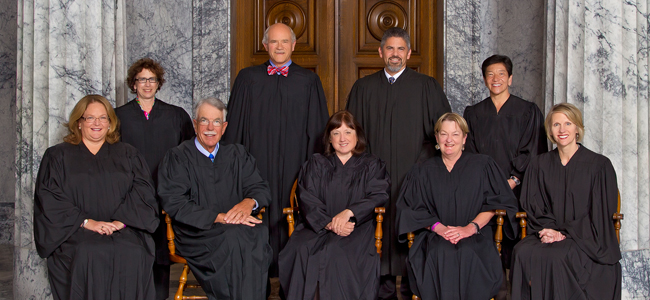
The dissenters disagreed with the majority in two important ways. Justices McCloud and González did not believe the Tribe had actually consented to state court jurisdiction.  Further, the dissenters would require an express “waiver of jurisdictional issues” pursuant to Williams v. Lee.

Following Outsource, the very rough voting patterns of the Washington State Supreme Court in modern Indian law cases, are as follows:

Untitled


Anthony Broadman is a partner at Galanda Broadman PLLC.  He can be reached at 206.321.2672, anthony@galandabroadman.com, or via www.galandabroadman.com.


Galanda & Broadman to Each Talk at 12th Annual Gaming Law Summit

Gabe Galanda is co-chairing the 12th Annual Gaming Law Summit and will discuss "Ethical Considerations," and Anthony Broadman will talk about "Indian Gaming Taxation."  The Summit will happen on December 11 and 12, 2014, in Seattle. 14.GAMWA Brochure ni_Page_1

Gabriel “Gabe” Galanda is the Managing Partner at Galanda Broadman. Anthony Broadman is also a partner with the firm. Gabe is a citizen of the Round Valley Indian Tribes. Galanda Broadman handles all varieties of gaming law matters.

Big Tobacco’s Latest Assault On Tribes

By Anthony Broadman

As recently as last year, Big Tobacco appeared to have forged a formidable alliance with both the feds and states against Tribal tobacco.  But when the ATF withdrew its position under the PACT Act, it pulled the lynchpin to that alliance.  Now, and by no coincidence, at least RJ Reynolds has turned on the feds in connection with Tribal Tobacco.

Last week, Reynolds filed suit against the U.S. Department of Agriculture in the latest attack in Big Tobacco’s war on Tribal economic development.  In the lawsuit, RJ Reynolds alleges that the USDA has failed to collect fees from tribal cigarette manufacturers, and in doing so has artificially inflated the amount that RJ Reynolds is required to pay.images-1

Of course, Big Tobacco cannot pursue Tribal entities directly, so it has targeted federal agencies—here, the USDA through the Administrative Procedures Act (“APA”).  RJ Reynolds alleges that the USDA refused to recalculate Reynolds’ share of fees because the evidence presented by the tobacco maker to the agency was insufficient.  Suffice it to say, however, Big Tobacco is not letting the feds off that easy.

The suit raises numerous red flags for tribes.  For one, tribes are indispensible parties who cannot be joined because of their sovereign status, warranting dismissal pursuant to Fed. R. Civ. Proc. 19.  In addition, if the USDA intends to take any action in connection with including tribal tobacco in its calculation of Tobacco Trust Fund fees, it will have to consult with affected Tribes pursuant to its consultation policy  or risk being sued by those Tribes under the APA.

In all, while RJ Reynolds may not succeed in prosecuting its lawsuit, the suit is another sign that Big Tobacco will keep the pressure on the federal government regarding tobacco in Indian Country.

Anthony Broadman is a partner at Galanda Broadman PLLC. He can be reached at 206.321.2672, anthony@galandabroadman.com, or via www.galandabroadman.com.


 

Gabe Galanda Named to Best Lawyers in America for 9th Year

Gabe Galanda has been honored as one of the Best Lawyers in America, in both Gaming Law and Native American Law, for the ninth straight year.  He has now received the award in each year from 2007 to 2015. Screenshot 2014-08-19 09.52.02

Gabriel “Gabe” Galanda is the Managing Partner at Galanda Broadman. He is a citizen of the Round Valley Indian Tribes. Gabe can be reached at 206.300.7801 or gabe@galandabroadman.com.

Edward Snowden and Attorney-Client Privileged Tribal Emails

According to Jurist:

American lawyers have been concerned for some time that the legally protected space for attorney-client communications is shrinking. But recent reports detailing massive electronic surveillance by the US government suggest truly confidential communications may largely be a thing of the past.

Documents leaked to the press over the past year by former NSA contractor Edward Snowden reveal that the US government is sweeping up vast amounts of private data and communications, including confidential imagesinformation related to ongoing legal matters and privileged communications between attorneys and their clients. . . .

Concerns are especially pronounced in contexts where the US government is an opposing legal party. . . . As one prominent public interest lawyer put it, fear of government surveillance makes sense in part because the government that holds all of the surveillance information is also "the adversary we're worried about."

Should tribes be concerned that the United Sates has swept up confidential emails and other electronic communications between tribal clients and lawyers?

Tribes and tribal lands have too frequently been referred to as havens for organized crime and, more recently, for terrorism, especially by way of gaming and tobacco industries.  So I would not rule out NSA surveillance in Indian Country.

And with tribes now duking it out in federal court with the likes of the holier-than-thou FBI and ATF, I, too, would not rule out the possibility of DOJ gaining access to the data and using it for litigation advantage.

Tribal lawyers and leaders, take note, and take precaution.

Gabriel “Gabe” Galanda is the Managing Partner at Galanda Broadman. He is a citizen of the Round Valley Indian Tribes. Gabe can be reached at 206.300.7801 or gabe@galandabroadman.com.

Beware of the Disenrollment Playbook

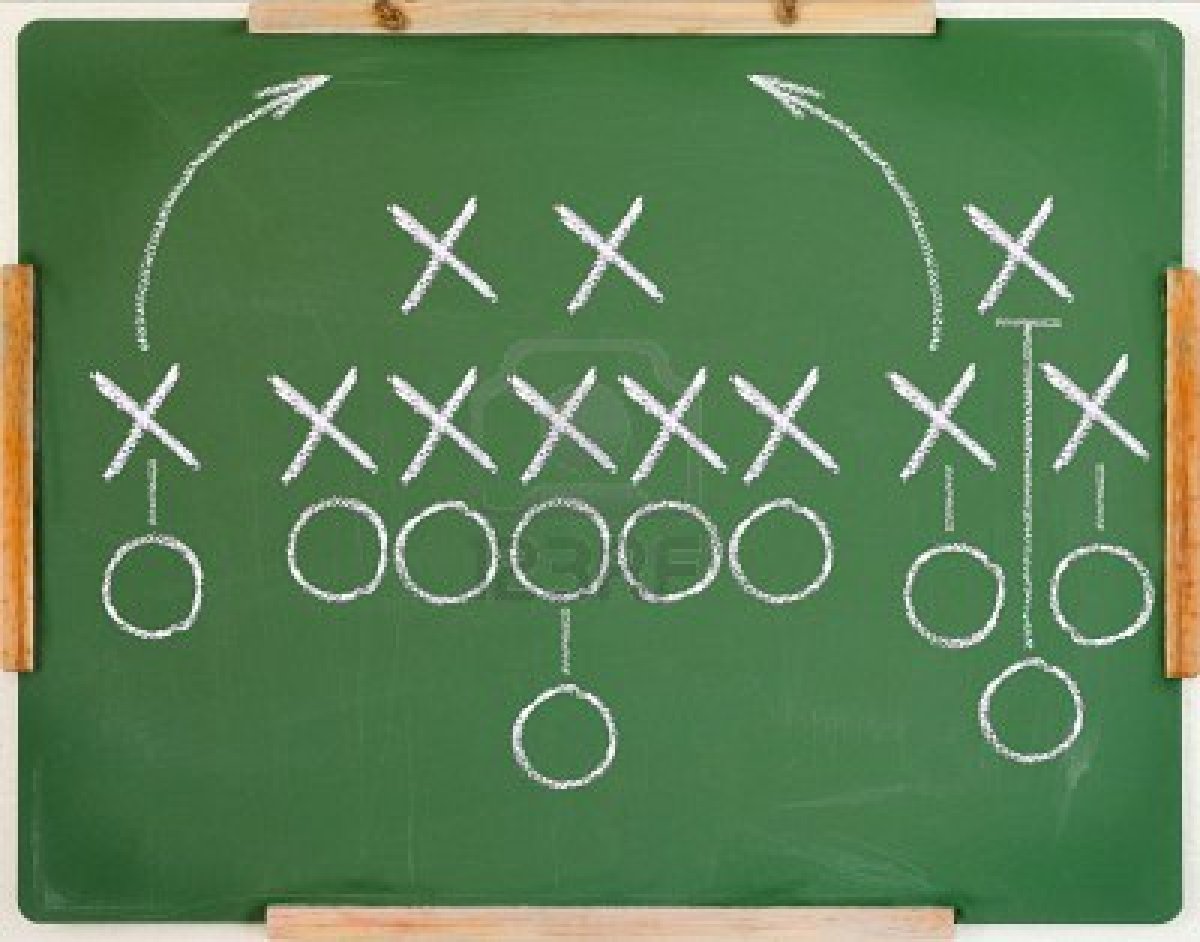
Over the last decade, lawyers--predominately non-Indian lawyers--have devised a set of plays to "win" the mass disenrollment of Indian citizens.  The plays are drawn up, even scripted, behind closed tribal doors, to further advantage offending tribal leaders on what is already an uneven political and legal playing field.  If you see or hear any of these plays being called, pay close attention. Or you and yours may be the next to play defense against disenrollment. 1347963852

Enrollment Audits--the beginning of a mass disenrollment effort (see "Auditing Tribal Sovereignty")

Battle of the Experts--engaging non-Indian, hired-gun genealogists or anthropologists (those who Vine Deloria, Jr., rightly called "culture vultures") to discount a family's lineage and disrespect the ancestors

No Magic Words--avoiding federal habeas corpus review under Poodry and Sweet by not saying "banished"

Provisional Disenrollment--denying equal rights to those members who are merely proposed for disenrollment, typically starting with the deprivation of gaming per capita monies (see "Tribal Per Capitas and Self-Termination")

Posthumous Disenrollment--disenrolling the dead, perhaps without notice to the living

Audibles--changing the rules of engagement as they go, to advantage those doing the disenrollment

Disenrollment Moratorium--once the politically unpopular members are disenrolled, impose a moratorium to prevent the disenrollment of those who accomplished the disenrollment

Galanda Broadman is an American Indian owned law firm dedicated to defending Indian rights.  The firm has represented nearly 500 disenrollees in disenrollment proceedings and contoversies since 2013.

Disenrollment: Severing The Seven Generations

In all of your deliberations...in your efforts at law making, in all your official acts, self-interest shall be cast into oblivion....Look and listen for the welfare of the whole people and have always in view not only the present but also the coming generations, even those whose faces are yet beneath the surface of the ground – the unborn of the future Nation. -- Great Law of the Iroqouis

While some tribes who terminate their own people, spare the ancestors by not “posthumously disenrolling” them, any disenrollment of a descendant amounts to disenrollment of the dead.

Today’s disenrollees descend from Treaty Chiefs, reservation founders, original allottees, termination defenders, and other tribal matriarchs and patriarchs.  Many of those ancestors signed a Treaty or accepted an Indian homestead, or defended those Indian holdings, to ensure that the coming “seven generations” would survive.article-2141789-1300CAC2000005DC-351_634x455

So when a tribe severs the ancestors’ so-called “down line” of lineal descendants,the ancestors are essentially disenrolled—or dismembered—too. The seven generations are severed.

What offending tribes fail to fully appreciate is that along with the jettisoned ancestors go the tribe’s legitimate ties to aboriginal lands, sacred sites, time-honored rites, and so much more that makes the tribe tribal.

Indeed, to disenroll is to cut off a tribe’s nose to spite its face.  It is self-dismemberment.

Gabriel “Gabe” Galanda is the Managing Partner at Galanda Broadman, an American Indian law firm dedicated to defending Indian rights. He is a citizen of the Round Valley Indian Tribes. Gabe can be reached at 206.300.7801 or gabe@galandabroadman.com.

Franchising With Tribes/In Indian Country

Fueled by the $26 billion Indian gaming industry, the country’s most famous restaurant franchises are moving to tribal lands like never before.   Subway, Burger King, Sonic, Arby’s—you name ‘em. images

Franchise lawyers need to appreciate that lawyering a franchise deal in Indian Country is akin to doing so in a foreign country.  A form franchise agreement is likely a square peg, in tribal reservation deals.  To illustrate:

Do federal franchise laws apply to the reservation franchisor?  Probably.  See Federal Power Comm’n v. Tuscarora Indian Nation, 362 U.S. 99, 116 (1960).

Do they apply to a tribal franchisee?   Probably not.  Cf. Multimedia Games, Inc. v. WLGC Acquisition Corp., 214 F. Supp. 2d 1131, 1131 (N.D. Okla. 2001).

Do state franchise laws apply to either party?  Nope.  Worcester v. Georgia, 31 U.S. 515, 559 (1832).

Do tribal laws apply to the franchisor?  Yep.  See e.g. Water Wheel Camp Recreational Area, Inc. v. LaRance, 642 F.3d 802 (9th Cir. 2011).

Does the United States need to approve the franchise agreement?  Maybe.  See 25 U.S.C. § 81.

Can the tribe tax the franchisor vis-à-vis its on-reservation activities?  Yep.  Washington v. Confederated Tribes of the Colville Indian Reservation, 447 U.S. 134 (1980).

Can the state?  Maybe.  White Mountain Apache Tribe v. Bracker, 448 U.S. 136 (1980).

The list of unique federal Indian and tribal legal issues goes on and on.  In all, franchisor beware—especially franchise counsel.

Gabriel “Gabe” Galanda is the Managing Partner at Galanda Broadman. He is a citizen of the Round Valley Indian Tribes. Gabe can be reached at 206.300.7801 or gabe@galandabroadman.com.

Disenrolling the Dead

Your dead cease to love you and the land of their nativity as soon as they pass the portals of the tomb and wander away beyond the stars. They are soon forgotten and never return. Our dead never forget this beautiful world that gave them being. They still . . . yearn in tender fond affection over the lonely hearted living, and often return from the happy hunting ground to visit, guide, console, and comfort them. -- Chief Seattle

There is perhaps nothing more reviling about disenrollment, than the disenrollment of ancestors, or what offending tribes call "posthumous disenrollment."

It has happened at Saginaw Chippewa, at Las Vegas Paiute, at Robinson Rancheria, and most recently, at Grand Ronde. And it could happen to your ancestors, and to you.

The reason the offending tribes--or more precisely, their lawyers--or even more precisely, their non-Indian lawyers--disenroll the dead is because many IRA tribal constitutions include language that says if you descend from an enrolled tribal member (and satisfy other requirements, like blood quantum), you are entitled to tribal membership too.

nrcs141p2_023298

As such, in order to disenroll large swaths of tribal members, as is happening at now epidemic levels, an offending tribe must go back multiple generations on a family's tree, to disenroll not only the living, but the dead.

Beyond rightful moral outrage to so disturbing and dishonoring the ancestors, the maneuver raises due process questions, especially insofar as an offending tribe does not give even the ancestors' living descendants notice or opportunity to be heard.

To some tribes death is so sacred that the community can never again utter an ancestor's name; they are to be left in peace.

To other tribes, nothing is sacred.

Gabriel “Gabe” Galanda is the Managing Partner at Galanda Broadman. He is a citizen of the Round Valley Indian Tribes. Gabe can be reached at 206.300.7801 or gabe@galandabroadman.com.