Beware: "Enrollment Audit" is Code for Disenrollment Witch-hunt

We are witnessing an increasing number of tribal enrollment audits. In our and our clients' experience, these "audits" are not about sorting out the truth of a tribal community's lineage.  Instead, they are a means to an end: mass disenrollment. audit

Perhaps more troubling than the notion of "auditing" Indian ancestry--hardly an indigenous custom or tradition--these audits are being performed by outsiders, most notably CPAs.  In other words, highly confidential tribal historical, anthropological and genealogical information is being disclosed to third-party corporate entities.  This time-honored information is boxed and shipped off of the reservation or scanned and uploaded to the cloud--nothing is sacred.

And even more troubling than that is the idea that consulting firms, even those professed to be "Native-owned," are actively marketing themselves to tribes for the opportunity to administer these witch-hunts.  One firm advertises tribal enrollment audits as a way of "managing your tribal rolls" and "re-evaluating your organizational growth strategies." Got snake oil?

In any event, if ever you hear the word "enrollment audit," put up your political dukes and fight the measure to its death.

Gabriel “Gabe” Galanda is the Managing Partner at Galanda Broadman. He is an enrolled member of the Round Valley Indian Tribes of Covelo, California. Gabe can be reached at 206.300.7801 or gabe@galandabroadman.com.

Reframing "The Debate Over Disenrollment"

It is with great admiration for my colleague Professor Duane Champagne that I must disagree with some of the underpinnings to his recent column, “The Debate Over Disenrollment.”  Here, I hope to help reframe that “debate." Professor Champagne suggests, like legions of others, that the 1978 Santa Clara v. Martinez bestows upon tribal governments some form of absolute power to disenroll Indians.  Most notably the U.S. Department of Interior has proclaimed, time and again, that Santa Clara requires “‘a proper respect’ for tribal sovereignty” and “‘cautions’ that [the Fed] tread lightly” in the realm of disenrollment, even in the face of related federal illegality.  Reliance on Santa Clara is outdated, and frankly, unhelpful in the face of what Professor David Wilkins rightly calls a “disenrollment epidemic.”

imagesAlthough Professor Champagne is correct that federal courts generally “do not have jurisdiction over tribal membership rules,” they do have jurisdiction over various Tribal disenrollment-related actions that implicate federal law and thus raise federal questions under 28 U.S.C. 1331.  For example, the trend of faction-driven Secretarial elections that further the targeted disenrollment of Indians under the guise of the federal Indian Reorganization Act, implicates the federal judiciary’s jurisdiction.  Likewise, the trend of denying proposed disenrollees tribally and federally guaranteed equal rights, such as gaming per capita distributions, implicates the federal Indian Gaming Regulatory Act.

It is only a matter of time before federal judges, in the spirit of judicial realism, begin to tackle disenrollment on the merits.  A recent Ninth Circuit Court of Appeals panel recently commented that “membership disputes have been proliferating in recent years, largely driven by the advent of Indian gaming, the revenues from which are distributed among tribal members.”  Alto v. Black (9th Cir. 2013).  Reading between the lines: the federal courts are tired of per capita-driven mass disenrollment disputes.  The United States' judges will eventually intercede to help put a stop to those disputes' proliferation, with the judges' hook being the rampant federal civil rights violations that accompany any mass Indian disenrollment.

Professor Champagne suggests that “[o]ften Indian disenrollment debates focus on specific membership rules particular to a given tribe, such as their traditional kinship system[s].”  The reality, though, is that trending mass tribal disenrollment efforts have little to do with tribal tradition-based membership requirements.  They instead involve artificial, federal membership constructs, like U.S. censuses and rolls, which can be “traced to the United States’ paternalistic assimilation policies of the 1930s.”  As Dr. Jay Miller observes, “no census was fully effective and portions of tribes were always missing both by accident and by malicious intent of U.S. or tribal officials.”

Disenrollments rooted in such non-indigenous constructs really do not “require deep understanding of tribal community, history, culture, and identity” as the professor suggests.  In fact, disenrollment typically has little to nothing to do with such Indian ideals.  Disenrollment is “predominately about race, and money.”  Even if a particular disenrollment dispute is not driven by those non-indigenous values—I do not know of one mass disenrollment that is not—“non-Indians may view such controversies as indicators of greed and corruption.”  And of course perception is reality, especially for Indians.1768978.t

Indeed, Professor Champagne’s main argument seems to be that “the whole of Indian tribal membership issues should not be brought into question because of the perceived actions of some.”  Yet as Jared Miller correctly observes, “tribal governments abandoning members en masse . . . harm their own bottom line by engendering negative media and investor perceptions. More critically, they threaten the bottom line of Indian businesses everywhere.”  Those tribes also threaten tribal self-governance, giving Indian sovereignty skeptics good reason to believe that tribal governments cannot properly handle membership without outside involvement.

In other words, the disenrollment actions of some nations do affect all tribal nations.  Among much other negativity, “there is a real risk that Congress or the U.S. Supreme Court might one day make new law in the area of tribal citizenship”—a risk that we can ill afford to take.  As such, Native America should make the whole of Indian tribal membership issues our collective business. “Too much is at stake to remain silent.”

Gabriel “Gabe” Galanda is the Managing Partner at Galanda Broadman. He is an enrolled member of the Round Valley Indian Tribes of Covelo, California. Gabe can be reached at 206.300.7801 or gabe@galandabroadman.com.

Gabe Galanda Honored by WSBA for Excellence in Diversity

AwardsHorizontalIdentity2014-PNG Gabe Galanda has been honored with the Excellence in Diversity Award by the Washington State Bar Association. He will be given the award at the WSBA's annual awards dinner in downtown Seattle on September 18, 2014.

Gabe is an enrolled member of the Round Valley Indian Tribes of California. He currently sits on the National Native American Bar Association Board of Directors, and is a past President of the Northwest Indian Bar Association and past Chair of the Washington State Bar Association Indian Law Section.  

Gabriel S. Galanda

He is being primarily honored for his work associated with Huy, a non-profit that provides economic, educational, rehabilitative and religious support for American Indian, Alaska Native, Native Hawaiian and other indigenous prisoners in the Pacific Northwest and throughout the United States.

In 2012, Gabe founded Huy--pronounced "Hoyt" in the Coast Salish Indian Lushootseed language, to mean "see you again/we never say goodbye."  He serves as the Chairman of Huy's Board of Advisors, and runs the non-profit through his law office.

Huy's most notable recent activities include two amicus curiae efforts before the U.S. Supreme Court, and advocacy before the United Nations and its Human Rights Committee, on behalf of American indigenous prisoners vis-a-vis their fundamental human rights to engage in traditional tribal religious worship.

Gabe is the Managing Partner of Galanda Broadman, PLLC, an American Indian-owned law firm dedicated to advancing and defending Indian rights.  The firm has offices in Seattle, Washington and Bend, Oregon.

Nike, N7 Should Get Off the Sidelines re Redskins Mascot

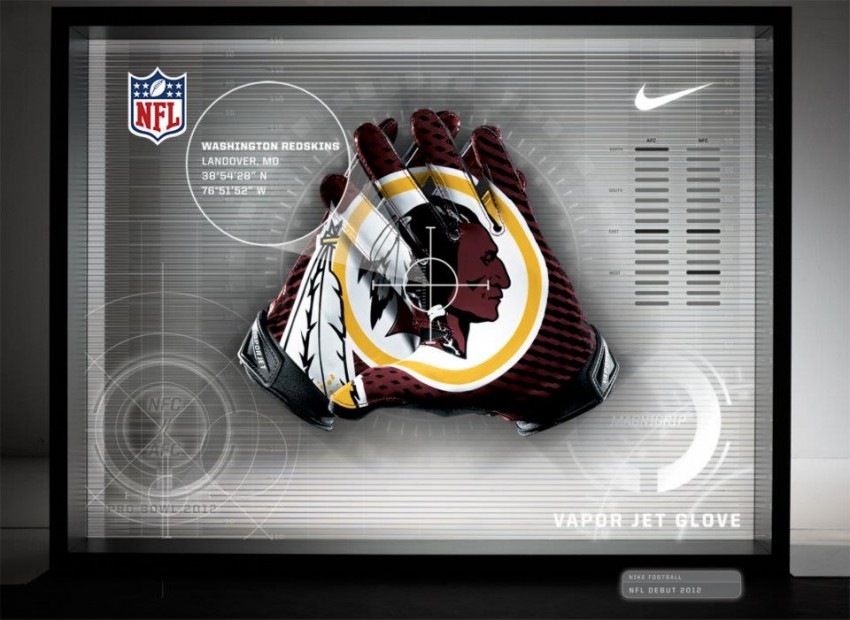
Nike and its N7 Fund have done some amazing things for Native America.  Yet the biggest sports brand on the planet stands on the sidelines of the "Change the Mascot" movement. It is understandable why some of America's biggest companies--Coca Cola and FedEx to name just two --are sitting out the Redskins mascot controversy. Money.  Big Money.

nike-vapor-jet-glove-pro-bowl-washington-redskins-850x620

But unlike those other Fortune 50 companies, Nike has specifically stated a "commitment to bring sport and all of its benefits to Native American and Aboriginal communities in the United States and Canada."  

Of course with that commitment comes business opportunity for Nike, and not merely through the N7 shoes and apparel line.  The much more lucrative play comes through the intangible economic benefits that adorn any well-advertised philanthropic venture like the N7 Fund.

It is rather hypocritical for Nike to "help Native American and Aboriginal youth recognize their proud history," yet sell sports merchandise bearing a logo historically associated with bloody Native American scalps when "in-depth studies that show the harm negative stereotypes and 'Indian' sports mascots have on Native youth."

Nike has thus far largely (but not entirely) ducked the Indian mascot controversy.  That is in part because although national tribal leaders have lambasted the likes of FedEx for not denouncing the Redskins mascot, they have looked past Nike and N7.  Native America has allowed the the world's #1 athletic apparel company to ignore its own social responsibility to denounce racism in professional sports--especially in the form of branded pro sports apparel.

Indeed, without the prominence of Nike and its ever-lasting Swoosh the Redskins mascot might just fade away.

n7And beyond a Nike pronouncement against the racist Redskins mascot being the proverbial "right thing to do," as sports marketing professionals point out, a new Washington NFL team logo "would be a boon for the National Football League and licensees such as Nike Inc., if previous pro-sports team switches are any indication."

It is time for Nike to walk the walk.  They certainly have the shoes in which to do so.

Gabriel “Gabe” Galanda is the Managing Partner at Galanda Broadman. He is an enrolled member of the Round Valley Indian Tribes of Covelo, California. Gabe can be reached at 206.300.7801 or gabe@galandabroadman.com.

Department of Justice Proposes an Indian Country-Specific Legislative Fix to Shelby County v. Holder

Last year in Shelby County v. Holder the Supreme Court struck down Section 4(b) of the Voting Rights Act (“VRA”), holding that “[o]ur country has changed” so that Section 5’s preclearance formula no longer “speaks to current conditions.”imgres
In essence, Section 5 of the VRA allowed federal administration enforcement of the voting laws, rather than judicial enforcement, by forbidding certain states and local governments from implementing “any voting qualification or prerequisite to voting, or standard, practice, or procedure with respect to voting” without preclearance from the Department of Justice (“DOJ”).  “Covered jurisdictions” — jurisdictions subject to preapproval obligation of Section 5 — were determined by utilizing a formula found in Section 4(b) of the VRA.  Section 4(b) designated as “covered” those jurisdictions that (a) had maintained a “test or device” — i.e., literacy or knowledge tests, good moral character requirement, voter registration materials, etc. — as a prerequisite to voting as of November 1, 1964, and had less than 50 percent voter registration or turnout in the 1964 Presidential election; (b) had a voting test or device and less than 50 percent voter registration or turnout as of 1968; or (c) had a voting test or device — including, this time, English-only voting materials in places where over five percent of voting-age citizens spoke a single language other than English — and less than 50 percent voter registration or turnout as of 1972.

As a result of this coverage formula, particularly redefinition of a “test or device” as English-only voting materials in 1975, numerous states and districts containing Indian reservations became covered.  The litigation that followed revealed not only that these jurisdictions continued to discriminate against Native American voters, but that Indian Country has not even gotten to the point of raising challenges to the complex contemporary vote dilution cases brought in significant numbers by other minorities.  Instead, Native Americans are still facing the antecedent issues regarding their inability to elect any representatives at all.  The Blackmoon v. Charles Mix County, No. 05-4017 (D.S.D.), litigation, for instance, revealed that under the County’s proposed voting plan there was “no reasonable probability that Native American voters could elect their candidate of choice” and that Native Americans were outright “discriminated against in registration and other parts of the voting process.”  Similar suits and proposed legislation submitted to the DOJ for preclearance revealed similar deficiencies.

Thus, shortly after the Shelby County decision was issued, I authored a law review article arguing that while it may be the case that the coverage formula does not “speak[] to current conditions” outside of Indian Country, this is not true within.  While the Section 4(b) formula may not be constitutional under Shelby County, I argued:

Indian-specific [voting] legislation is justified, necessary, and indispensable to the protection of the Native vote.  This is particularly true considering Congress’ plenary and exclusive authority over Indian affairs, including relations between states and tribes.  Indeed, if there is any area where limitations placed upon Congress by the Fifteenth Amendment would not prevent preclearance legislation, it is in Indian Country, where Congress has an affirmative trust and fiduciary obligation to ensure that Native American voters are fully enfranchised.

On June 9, the DOJ took the first step in making this suggestion a reality by initiating formal consultation between Tribal officials and the DOJ to discuss whether the DOJ should recommend to Congress Indian-specific legislation that would address the gaps created by the Shelby County decision.  The DOJ cites as Congress's authority to enact this legislation the "plenary power to legislate in respect to Indian tribes" and "Congress's unique obligation toward Indians -- in particular, its responsibility to ensure that they are included fully within the modern body politic -- [which] gives Congress the power to require fair treatment for American Indian and Alaska native voters."

The DOJ is set to circulate a consultation schedule by July 9.  All tribes are invited to offer input on the proposed legislation.

Ryan Dreveskracht is an Associate at Galanda Broadman, PLLC.  His practice focuses on representing tribal governments in public affairs, energy, gaming, taxation, and general economic development.  He can be reached at 206.909.3842 or ryan@galandabroadman.com. 

Galanda and Broadman Each Receive SuperLawyers Honor

Tribal lawyers Gabe Galanda and Anthony Broadman were each honored by Super Lawyers magazine for 2014; Gabe as a Washington “Super Lawyer” and Anthony as a “Rising Star.”

photo-1

The award follows several recent honors for Galanda Broadman and its founding partners.  Galanda Broadman has received a prestigious Tier 1 ranking from U.S. News – Best Lawyers “Best Law Firms,” in the arena of Native American Law.

Gabe has also been named to The Best Lawyers in America in the practice areas of both Gaming Law and Native American Law, in 2014 and for the prior seven consecutive years. He was recently named a “Difference Maker” by the American Bar Association, too, with Anthony having been honored for his outstanding service by the Washington State Bar Association.

Galanda Broadman, “An Indian Country Law Firm,” is dedicated to advancing tribal legal rights and Indian business interests.  The firm, with six lawyers and offices in Seattle, Washington and Bend, Oregon, represents tribal governments, businesses and members in critical litigation, business and regulatory matters, especially in matters of Indian Treaty rights, tribal sovereignty and taxation.

Gabe is an enrolled member of the Round Valley Indian Tribes of California. He currently sits on the National Native American Bar Association (NNABA) Board of Directors, and is a past President of the Northwest Indian Bar Association and past Chair of the Washington State Bar Association (WSBA) Indian Law Section.

Anthony  is a past Chair of the WSBA Administrative Law Section, and author of “Administrative Law in Washington Indian Country.”  He is a former Trustee of the WSBA Indian Law Section, and also serves as Editor-in-Chief of the Section’s Indian Law Newsletter.

New Tribal Energy Development Grants Available for FY 2014

On Tuesday, Assistant Secretary-Indian Affairs Kevin K. Washburn announced that the Office of Indian Energy and Economic Development (IEED) is soliciting grant proposals from federally recognized tribes for projects that promote the development of energy on Indian trust lands.  IEED has $11 million available in FY 2014 for grants.

While energy development in Indian Country has been slow going, recent changes in the law have provoked some interest in the initial stages of Indian Country energy development.  While some legal scholars have questioned the sincerity of these changes in law -- particularly because "Congress has shown time and time again that it is willing to pass these laws, but not to fund them," -- it appears that the Bureau of Indian Affairs and its IIED may, finally, be putting its money where its mouth is.StateLocalClimatePic

The Department's published solicitation can be found here.  Proposals must be submitted no later than 75 calendar days from the announcement date.

Ryan Dreveskracht is an Associate at Galanda Broadman PLLC, of Seattle, an American Indian majority-owned law firm. His practice focuses on representing businesses and tribal governments in public affairs, energy, gaming, taxation, and general economic development. He can be reached at 206.909.3842 or ryan@galandabroadman.com.

Gabe Galanda Featured Law360 Commentator Re Bay Mills Decision

After the Supreme Court's shocking decision in favor of the Bay Mills Indian Country, leading law blog, Law360, quoted Gabe Galanda at length about the decision, in "Bay Mills Ruling To Fuel New Fights Over Tribal Immunity."

“BayMills is the most significant Supreme Court win for Native America in the last 25 years, maybe ever," Gabriel S. Galanda 
of Galanda Broadman PLLC told Law360. "It categorically affirms not only tribal sovereign immunity from state action, but also tribal sovereignty and Indian gaming in general. ... Still, tribal governments are nowhere near out of the woods.” 

For one thing, both Justice Elena Kagan, in a footnote to the majority opinion, and Justice Clarence Thomas in his dissent, alluded to an open question that remains: Does tribal sovereign immunity extend to an off-reservation tort, like an automobile accident caused by a drunk driver or casino patron? . . .

Lower courts could take the Supreme Court opinion as a cue to abandon sovereign immunity precedent if there's “special justification,” such as if a claimant were unable to secure some form of remedy otherwise, experts say.

“That passage [in the majority opinion] can be read by lower court judges as a signal to develop a remedy for a tort claimant, especially off-reservation, and allow the federal appellate process to go from there,” Galanda said.

Gabe and his partner Anthony Broadman were previously very critical of those federal powers that be, in particular, who did not moot the case before it reached the typically anti-Indian High Court (see here, and here.)

Gabriel “Gabe” Galanda is the Managing Partner at Galanda Broadman. He is an enrolled member of the Round Valley Indian Tribes of Covelo, California. Gabe can be reached at 206.300.7801 or gabe@galandabroadman.com.

Gabe Galanda Publishes Re: Local/Global Native Prisoners' Religious Rights Movement

Gabriel Galanda published “To Geneva With Love: Native Prisoners’ Religious Rights Movement Goes Global.” The article appears in the May edition of King County’s Bar Bulletin, which is themed “Curtain.” The article begins with a citation to a famous U.S. Supreme Court prisoners’ rights case:

There is no iron curtain drawn be- tween the Constitution and the prisons of this country.” Nor is there an iron curtain drawn between international human rights norms and American prisons, especially insofar as Native American prisoners — or internationally speaking, American indigenous prisoners — are concerned.

Gabe goes on to explain how a local, grassroots, Native prisoners’ religious rights advocacy movement has ascended to national and international heights. He details various local, national and international legal and political interventions by the Native prisoners’ rights non-profit, Huy, and its allies, focusing on its advocacy via the United Nations:

By 2013, Huy aligned with longtime Native religious rights warriors, the Native American Rights Fund in Denver and the American Civil Liberties Union’s national and local chapters, to grieve the religious plight of Native inmates in state prisons throughout the United States to even higher powers. That coalition filed letters of allegation with the United Nations Office of the High Commissioner for Human Rights’ Special Rapporteur on the Rights of Indigenous Peoples, as well as the U.N. Human Rights Committee . . .

In June 2013, the Special Rapporteur on the Rights of Indigenous Peoples, joined by the U.N. Special Rapporteur on Freedom of Religion or Belief, wrote the U.S. State Department, requesting that within 60 days the government respond to the Huy coalition’s allegations and “provide any additional information it deems relevant to the situation.” The special rapporteurs posed a series of questions, including: san-quentin-sweat-lodge-by-nancy-mullane

What measures exist to ensure the protection of the religious freedoms of Native American prisoners in state and local prisons? Specifically, what legal, policy or programmatic actions, if any, have federal and state Government authorities taken to ensure that Native American prisoners are able to engage in religious ceremonies and traditional practices as well as have access to religious items in state and local prisons?

Almost a year later, the State Department has yet to respond in any way to the U.N. special rapporteurs.

The United States’ continued silence is indicative of its and other nations’ failure to respect the right of American indigenous prisoners to freely exercise their religion, and to afford those prisoners with effective remedies when state correctional agencies and officers violate their rights.

Gabriel “Gabe” Galanda is the Managing Partner at Galanda Broadman. He is an enrolled member of the Round Valley Indian Tribes of Covelo, California, and the founder of Huy (www.huycares.org) and Chairman of the Huy Board of Advisors. Gabe can be reached at 206.300.7801 or gabe@galandabroadman.com.